
Bitcoin Prediction Markets and Polymarket-Style Wagering
 Available in AU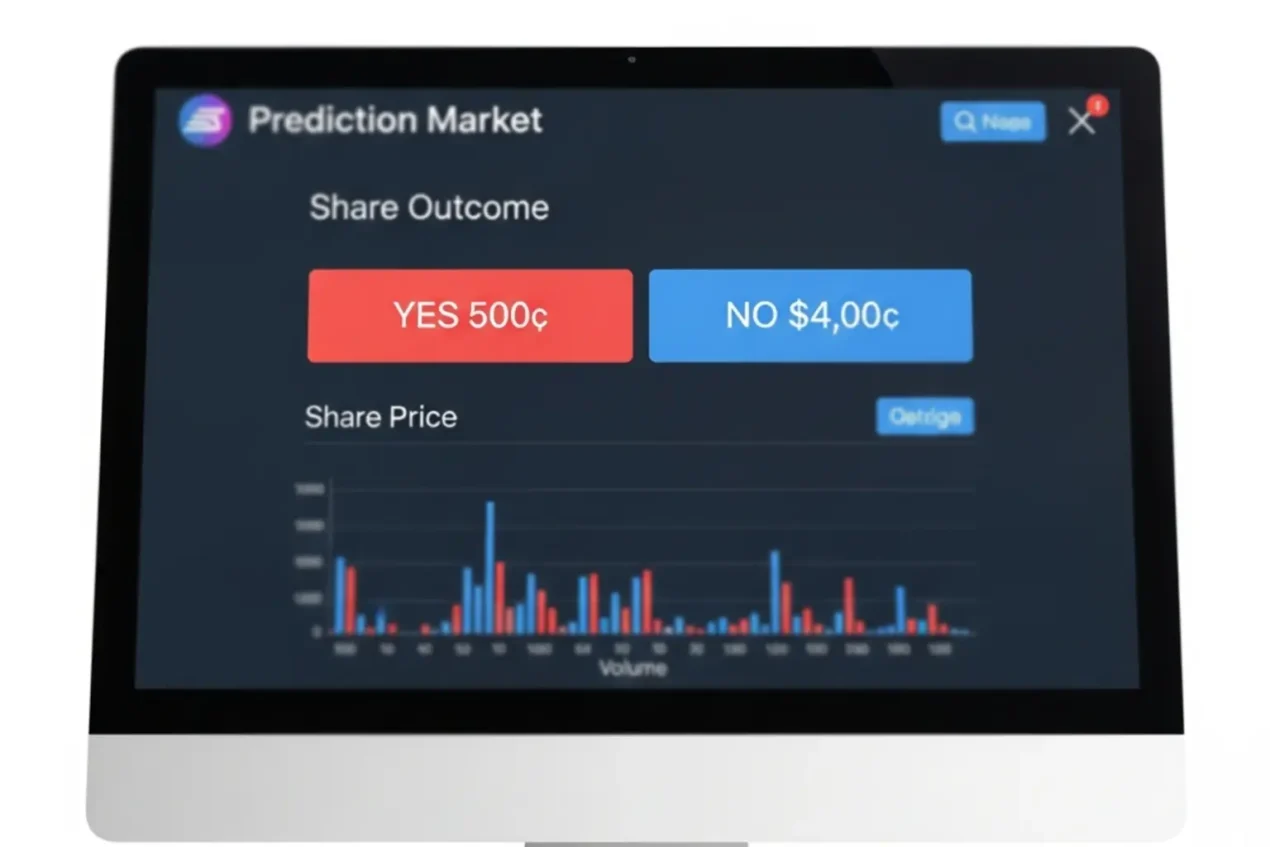
Why Prediction Markets Sit Next to Sportsbooks, Not On Top
A reader told me last year he’d “discovered” prediction markets while trying to bet on a US election outcome. His sportsbook wouldn’t take the bet; a Polymarket-style platform did. He loved the experience until it came time to bet on his beloved A-League — the prediction market’s liquidity on Australian football was so thin his proposed stake would have moved the price against him by 15 per cent. He went back to his sportsbook for everything except event-type markets. That’s exactly the right instinct, and it captures why these two categories coexist rather than compete.
Prediction markets and sportsbooks share a crypto-native payment rail and a basic idea — stake on an outcome, win if you’re right — but they work fundamentally differently. The scale of what Polymarket-style platforms became visible was dramatic: Polymarket’s trading volume jumped from US$62 million in May 2024 to US$2.1 billion in October 2024, a +3,268 per cent rise across six months. That growth came almost entirely from political markets, not sports, and understanding why tells you something important about where prediction markets fit in your betting toolkit.
The argument I’ll make in this article is that prediction markets are an excellent complement to a crypto sportsbook for specific kinds of bets, but a poor substitute for mainstream sports betting. Getting the use case right matters because the wrong choice costs you meaningfully — either in slippage on thin markets, or in missed opportunity when a sportsbook simply doesn’t list the bet you want.
The on-chain variant is covered in DEX sportsbooks.
Share Pricing vs Fixed-Odds: Two Worldviews
The architectural difference between the two systems is the foundation of everything else. Let me build it up slowly.
A sportsbook runs fixed-odds markets. You place a bet at the odds the book has posted, at the moment you click. If the book’s price was 2.20 decimal, your stake locks in at 2.20 regardless of what happens to the market afterwards. The book is the counterparty, taking on whatever risk your bet represents on their balance sheet. Win, they pay you; lose, they keep your stake. The book’s expected profit is the vig — the overround between the sum of implied probabilities and 100 per cent.
A prediction market runs share-based pricing. Each outcome is a tradeable share. A “yes” share on the proposition “Team A wins” trades at some price between 0 and 1 dollar, representing the market’s collective estimate of the probability that Team A wins. You buy shares at the current market price; the price moves as other traders buy and sell. When the event resolves, yes shares pay out $1 each if correct, $0 if not. The market itself is the counterparty — you’re trading against other participants, and the protocol takes a small fee on volume rather than running a margin against you.
The mental difference matters. On a sportsbook you place a bet. On a prediction market you’re effectively trading a position that can be exited at any time by selling your shares into the market. Your mark-to-market P&L changes continuously as the probability of the outcome shifts, and you can lock in profit by closing the position early if you like.
For mainstream sports with liquid sportsbooks, the sportsbook model tends to give tighter prices and larger limits. A major sportsbook on a marquee football match might have 3-4 per cent hold with multi-million-dollar limits. The equivalent market on a prediction platform might have wider bid-ask spreads and much smaller size before slippage kicks in.
For event-type bets — elections, commodity prices, geopolitical outcomes, “will X happen by Y date” — prediction markets are often the only game in town. Sportsbooks limit themselves to sports-adjacent events; prediction markets will list propositions on almost anything with a verifiable resolution. That’s the structural niche prediction markets fill.
One practical note: the odds on prediction markets can be expressed in share price (cents on the dollar) or converted to traditional odds formats like decimal or American. The conversion math is the same as I covered in the piece on Bitcoin odds formats — a share trading at 62 cents is equivalent to decimal odds of 1.613, which is -164 American.
How Markets Actually Resolve: Oracles, Committees, Disputes
On a sportsbook, bet resolution is straightforward — the book reads the final score from a trusted data feed and settles the bet. On a prediction market, resolution is a genuinely harder problem because the market is trustless and anyone could try to game resolution for profit.
Three main resolution models have emerged across prediction platforms.
Oracle-reported resolution. An external data oracle — sometimes a centralised feed, sometimes a decentralised network — reports the outcome to the smart contract. The contract pays out based on the oracle’s report. This works cleanly for events with unambiguous outcomes and trusted data sources. It breaks on ambiguous events or when the oracle itself becomes a point of contention.
Committee-based resolution. A designated committee of reputable actors votes on the outcome. The committee is trusted to resolve markets accurately in exchange for fees or protocol tokens. This approach scales to subjective events but introduces trust dependencies that pure-blockchain enthusiasts object to.
Dispute-driven resolution. The market proposes a resolution based on oracle data or committee vote, and the resolution becomes final after a challenge period during which any party can dispute it by staking bond capital. Disputed resolutions go to a higher-level arbitration process. This model, used by UMA’s oracle and several prediction platforms built on it, balances efficiency in the common case with dispute-handling for the hard cases.
Edge-case resolution is where prediction markets show their limits. A sports event might be rained off, a match voided, an outcome voided on integrity grounds — and the prediction market needs rules for each case. Reading the specific market’s rules before staking is critical. A market listed as “Team A wins the grand final by any margin” has to define what happens if the grand final is cancelled, what counts as “any margin” in overtime, and what happens if the competition structure changes mid-season. Edge cases that a sportsbook handles by referring to its T&Cs become governance crises on a prediction market.
Disputed resolutions on major prediction platforms have created real friction during high-profile events. Users with positions on the disputed side can lose substantial sums if the resolution goes against them, and the arbitration process is slow and imperfect. As prediction markets grow, the edge-case problem will either get better through more sophisticated rule sets or worse through larger stakes amplifying the consequences.
Liquidity: The 2024-2025 Volume Explosion in Context
The numbers behind the prediction market growth are striking, but they come with nuance worth unpacking.
Polymarket’s volume jumped from US$62 million in May 2024 to US$2.1 billion in October 2024, a +3,268 per cent increase across six months. That number has been widely cited as evidence that prediction markets have arrived as a mainstream product, and at a high level that’s right — prediction markets found real product-market fit during 2024 and the user base expanded dramatically.
The nuance: the volume was heavily concentrated. A substantial portion came from a relatively small number of political markets — US election markets, specific policy-outcome markets, geopolitical-event markets. Sports markets on the same platforms represented a small fraction of the volume despite being the most direct analogue to traditional sportsbook products. If you pulled the political markets out of the volume numbers, prediction-market growth on sports specifically would look far less dramatic.
Tim Berners-Lee’s general comment on cryptocurrencies — that crypto activity is “only speculative” and “obviously that’s really dangerous” — reflects a scepticism about crypto as an investment category that carries over to some assessments of prediction markets. Whether you agree or not, the fact that the political-market volume dominates the sports-market volume tells you something about who’s using these platforms and why. The product is much more useful for trading macro-level event outcomes than for match-level sports wagering.
Liquidity depth on any specific prediction market varies enormously. A major US political market can have tens of millions of dollars in two-sided liquidity, with shares trading at tight bid-ask spreads. An A-League match on the same platform might have A$5,000 of liquidity on each side — meaning any bet above A$500 starts to move the price against you significantly. Understanding the depth of your specific market before you stake is essential and easy to check: most platforms show the order book directly, and the order-book shape tells you how much size you can move without meaningful slippage.
For serious sports betting, traditional sportsbooks typically win on liquidity because they’re market-making against their own balance sheet rather than requiring user counterparties. The sportsbook can accept A$50,000 on a main-line market because the book’s risk desk is comfortable carrying the exposure. A prediction market can only absorb what other traders are willing to take the other side of at the current price.
Sports Markets on Prediction Platforms: What’s Different
When prediction platforms do list sports markets, the user experience differs from a sportsbook’s in specific ways that matter.
Time-to-settlement. Sportsbooks settle bets within minutes of an event ending. Prediction markets settle when the oracle or committee reports, which can take hours or days depending on the platform and the specific market. For short-horizon bets this is annoying; for longer-horizon bets it rarely matters.
Market depth at scale. A A-League match on a major sportsbook might have limits of A$20,000 or more on the main markets. The same match on a prediction platform might only have A$2,000 of available liquidity before you start moving the price. For recreational punters, either is fine. For anyone betting larger than A$500-A$1,000 at a time, the liquidity gap becomes noticeable.
Market variety. Prediction platforms often list unusual sports markets that sportsbooks don’t touch — “Team A wins by more than 15 points AND Player X scores 20+” as a single market, or “Which player will be named MVP of the playoff series” as a multi-outcome market. These combinatorial markets are hard to find elsewhere.
Early exit mechanics. The ability to sell your position back into the market at any time is the killer feature prediction markets offer that sportsbooks don’t replicate cleanly. If you bet on Team A pre-match and they jump out to a strong start, you can sell your “yes” shares at a higher price immediately, locking in profit without waiting for match end. Sportsbook cash-out replicates this in concept but with an additional margin that makes the mechanics less efficient. The cash-out comparison deserves its own treatment — prediction markets effectively eliminate the cash-out margin, which changes the EV calculation for anyone who likes to lock profits.
Cross-event composability. On prediction platforms, you can often construct positions combining multiple markets — if “Team A wins” and “Team X wins” are two separate binary markets, you can effectively build a parlay by taking positions in both, and the positions can be partially exited independently. Sportsbook parlays are single atomic products that don’t offer the same flexibility.
Where prediction markets lose. Banal, high-liquidity sports bets are where sportsbook execution simply dominates. The main-line moneyline on an NFL game will always have tighter prices and larger limits at a competent sportsbook than at a prediction market. Using a prediction market for routine sports betting is paying for flexibility you don’t need and giving up the efficiency you do.
Is a prediction market legally the same as a sportsbook?
In most jurisdictions, no. Prediction markets are typically regulated under different frameworks — sometimes as commodity exchanges, sometimes as event contracts, sometimes under bespoke regimes. The legality for users varies too. In the US, some prediction platforms require formal US regulatory approval that most haven’t obtained. In Australia, prediction platforms occupy a grey zone that neither the standard sports-betting licences nor the financial regulator clearly covers. Before staking meaningfully, check your specific jurisdiction’s treatment.
Can I withdraw a losing share early at a partial price?
Yes, this is one of prediction markets’ distinctive features. If you bought a ‘yes’ share at 62 cents and the market price has dropped to 30 cents, you can sell at 30 cents and exit the position for a 32-cent loss per share rather than waiting for the market to resolve at either $1 or $0. The early exit is executed by selling into the order book, so liquidity matters — thin markets may not have buyers at the price you want.
Why do prediction markets often show tighter odds on politics than on sports?
Because the user base is more politically engaged than sports-engaged on most prediction platforms. The volume drives the liquidity, the liquidity drives the tightness. Political markets on major platforms see millions in daily volume; sports markets often see low four figures. Tight prices follow the crowd, and the crowd on prediction platforms has historically been more interested in elections than in match results.
Created by the "" editorial team.The wider context sits in our data-driven guide to Bitcoin betting.