
Bitcoin Odds Formats Explained: American, Decimal and Fractional
 Available in AU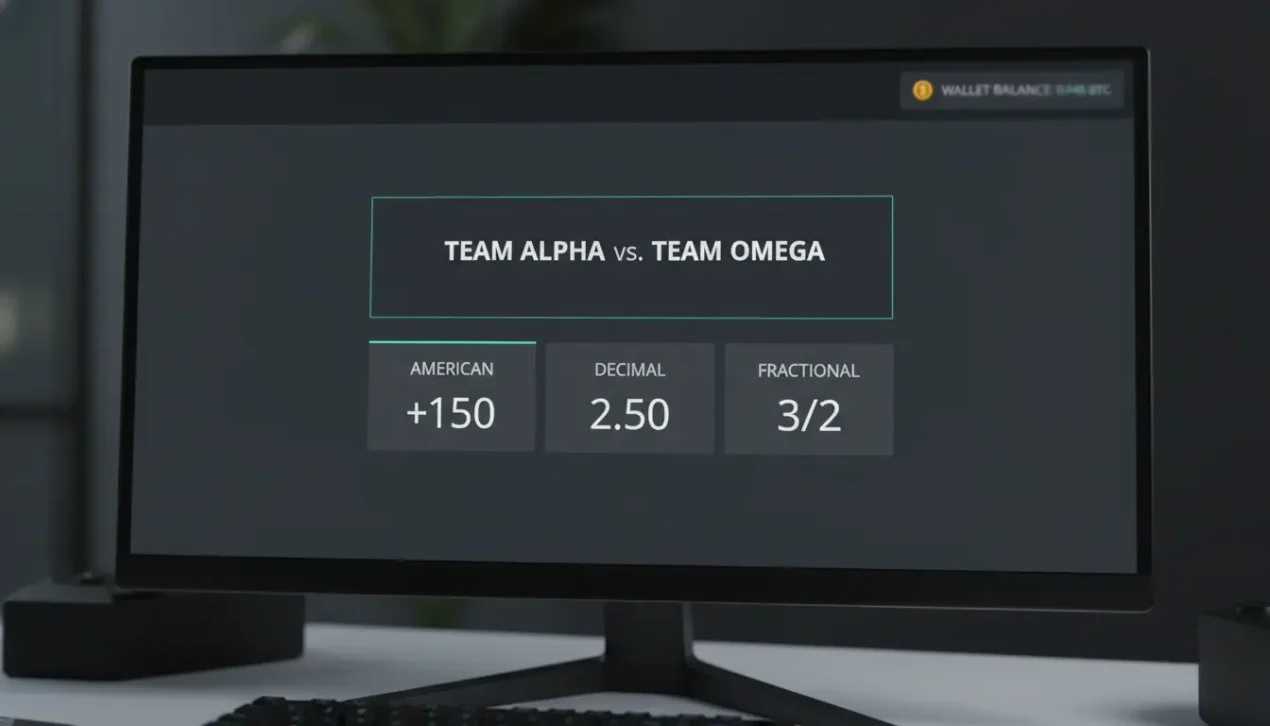
Why Crypto Books Expose All Three Odds Formats
Walk into a Sydney TAB and every line is decimal: 2.25, 1.75, 3.50. Open a sportsbook in Vegas and everything is American: -110, +220, -325. Pop into an English high-street bookmaker and half the boards are fractional: 11/4, 6/5, 9/2. Each format grew up in its own geography and refuses to die when its users log into the internet. Crypto sportsbooks, which serve users from all three traditions at once, solved the problem by letting you flip between formats in one click.
This sounds like a UI convenience. It’s actually strategically important. A bettor who can only read one format is handicapped when comparing across books, across markets and across chains. During 2024, the average crypto bet grew 1.4× in size while fiat stakes stayed flat — the crypto bettor is betting bigger per ticket, and a one-format bettor pricing a big stake against the wrong book is the one most punished by format illiteracy.
The aggregate Crypto Bet Sum in 2024 grew 18.7 per cent year-over-year even as Crypto Bet Count actually dropped 12.8 per cent, reflecting more deliberate, larger bets rather than higher frequency. Fewer decisions, each one carrying more weight — which makes the arithmetic behind those decisions worth more attention, not less. This article is the arithmetic.
Behind the price sits the house edge and vig.
American Odds: +/- and What the Break-Even Means
American odds are the format Americans insist on, and they’re the most confusing to non-Americans until the logic clicks. Then they become oddly intuitive.
The format pivots around 100. A negative number tells you how much you need to stake to win 100. A positive number tells you how much you win from staking 100. At -150, you stake A$150 to win A$100 (plus your A$150 back, so A$250 total return). At +150, you stake A$100 to win A$150 (plus your A$100 back, so A$250 total return).
Implied probability converts cleanly. For negative odds, implied probability is (absolute value) / (absolute value + 100). So -150 is 150 / 250 = 60 per cent implied. For positive odds, implied probability is 100 / (odds + 100). So +150 is 100 / 250 = 40 per cent implied. Those two numbers add to 100 per cent on a perfectly priced two-way market; in reality they add to slightly over 100 per cent, and that surplus is the book’s vig.
The break-even concept that American odds make obvious: at -110 (the standard “fair” price on a US coin-flip market), you need to win 110 / 210 = 52.4 per cent of similar bets just to break even. That’s the number that kills casual bettors. Every -110 wager is a 52.4 per cent hurdle, not a 50 per cent hurdle. The extra 2.4 per cent is what you pay the book for accepting the wager.
In BTC terms, nothing changes. A -110 bet of 0.01 BTC wins 0.01 × (100/110) = about 0.00909 BTC if it lands. Lose, and you’re down 0.01 BTC. The format is currency-neutral — the same arithmetic whether your stake is in sats, dollars or dirhams.
Decimal Odds: The Cleanest Format for BTC Math
Decimal odds are what I’d choose if I could wipe the industry and start fresh. They give you the total payout multiplier in one number, and the arithmetic on BTC stakes becomes trivially fast mental maths.
A decimal odd of 2.00 means: stake A$100, get A$200 back total (including the stake). Decimal 2.75 means: stake A$100, get A$275 back. Decimal 1.50 means: stake A$100, get A$150 back. The number you see is the total return multiplier, so a 0.005 BTC stake at 2.75 decimal returns 0.01375 BTC. You just multiply. No arithmetic with imaginary 100-unit baselines, no negative signs.
Implied probability from decimal odds is the most elegant conversion in betting: 1 divided by the decimal odd. 2.00 decimal = 1/2.00 = 50 per cent. 2.75 decimal = 1/2.75 = 36.4 per cent. 1.50 decimal = 1/1.50 = 66.7 per cent. That simplicity is why market modellers, arbitrage traders and sharp bettors overwhelmingly use decimal internally regardless of how the book displays.
For BTC-specific betting, decimal also avoids precision errors. When you’re working with sats-level stakes and want to know exactly what a 1,500-sat bet returns at different odds, “1,500 × 2.45 = 3,675 sats” is a calculation you can do in your head during the 20 seconds a live market is open. The same math in American odds requires two conversion steps first.
The mental hurdle some bettors face with decimal: remembering that the stake is included in the payout number. Decimal 2.00 is “even money” — stake and profit are equal. American +100 is the equivalent. First-time decimal users sometimes misread 2.00 as “double your money on top of stake,” which it isn’t.
Fractional Odds: British Habit, Useful Anywhere
Fractional odds are what British bookies and horse-racing boards have always used. The format shows the profit-to-stake ratio as a fraction. 5/1 means: stake A$1, profit A$5 (total return A$6). 1/4 means: stake A$4, profit A$1 (total return A$5). 11/4 means: stake A$4, profit A$11 (total return A$15).
Converting fractional to decimal is easy: (numerator + denominator) / denominator. So 5/1 becomes 6/1 = 6.00 decimal. 11/4 becomes 15/4 = 3.75 decimal. 1/4 becomes 5/4 = 1.25 decimal.
Implied probability from fractional odds: denominator / (numerator + denominator). 5/1 = 1/6 = 16.7 per cent. 11/4 = 4/15 = 26.7 per cent. 1/4 = 4/5 = 80 per cent.
The format’s virtue is intuitive reading when the odds are round numbers. “5/1” reads as “five to one” and everyone understands that means the underdog at a five-to-one ratio. The format’s defect is that comparing 11/8 and 23/20 mentally is harder than comparing 2.375 and 2.15 decimal. Fractional is great for round-number bar conversations, worse for sharp sportsbook math.
Most crypto sportsbooks display fractional mostly as a legacy courtesy for British users who insist on it. Behind the scenes, every modern sportsbook models in decimal and converts for display. If you never see fractional, you’ll never need to work with it. If your book is UK-facing and defaults to fractional, you can almost always switch in settings.
Converting Odds to Implied Probability in Your Head
Implied probability is the single most useful number in sports betting, and the reason to be comfortable in all three formats is that you can compare prices across books instantly if you can extract the implied probability fast.
From decimal: divide 1 by the odd. 2.00 is 50 per cent. 2.50 is 40 per cent. 3.00 is 33 per cent. 1.80 is 55.6 per cent. Practice until the common values are memorised.
From American negatives: odds divided by (odds + 100). -110 is 110/210 = 52.4 per cent. -150 is 150/250 = 60 per cent. -200 is 200/300 = 66.7 per cent. -400 is 400/500 = 80 per cent.
From American positives: 100 divided by (odds + 100). +100 is 100/200 = 50 per cent. +150 is 100/250 = 40 per cent. +250 is 100/350 = 28.6 per cent.
From fractional: denominator divided by (numerator + denominator). 1/1 is 1/2 = 50 per cent. 3/1 is 1/4 = 25 per cent. 7/2 is 2/9 = 22.2 per cent.
Why this matters for actual betting. Say you’re looking at a live BTC bet on an A-League match and Book 1 is offering 2.15 decimal while Book 2 is offering -118 American. Which is the better price? Convert: 2.15 decimal = 46.5 per cent implied; -118 American = 118/218 = 54.1 per cent implied. Wait — those aren’t the same market. Let me use a cleaner example. Book 1 offers 2.15 decimal (46.5 per cent). Book 2 offers +115 American (100/215 = 46.5 per cent). Same price, different format. Being able to check that in your head in five seconds is the reason to internalise these conversions.
The broader principle: once you’re comparing implied probabilities rather than raw odds, you can see immediately which book is offering the best price, and you can calculate the vig on any market by summing the implied probabilities of all outcomes. A two-way market where both sides add to 105 per cent has a 5 per cent vig (calculated as (sum – 100) / sum = 5/105 = 4.76 per cent hold). That arithmetic is the backbone of book-selection, and the deeper maths on how to compare books without getting fooled lives in the piece on reading the house edge and vig on crypto sportsbooks.
Do crypto sportsbooks ever show odds in BTC rather than USD?
Odds themselves are unitless — a decimal 2.00 or an American -110 is a ratio, not a currency. What some crypto books do display differently is the payout preview: showing you ‘0.01855 BTC return’ instead of ‘A$1,200 return.’ The odds stay the same across currencies; only the stake and payout are denominated. If your book shows stakes in BTC but converts to USD for display, that’s a setting, not a pricing difference.
Why does decimal odds of 1.91 feel worse than -110 when they are the same?
They are the same price — -110 American converts to exactly 1.909 decimal, and the implied probability is identical at 52.4 per cent. The psychological difference is that 1.91 looks like ‘less than 2,’ which reads as a bad return, while -110 looks like a ‘standard’ price Americans are used to. Format familiarity shapes perception. Neither is a better deal than the other; both are the same break-even threshold.
Does format choice change my expected return at all?
No. Expected return is a function of the true probability versus the implied probability in the odds, and that relationship is format-agnostic. What format choice can affect is decision speed — a bettor fluent in decimal can compare prices faster than one fumbling through American-to-decimal conversions on a live market. Speed of decision is not the same as mathematical edge, but in-play it can determine whether you catch a move before the line resets.
Created by the "" editorial team.The wider context sits in our data-driven guide to Bitcoin betting.