
Smart Contract Sportsbooks on EOS, Polygon and Avalanche
 Available in AU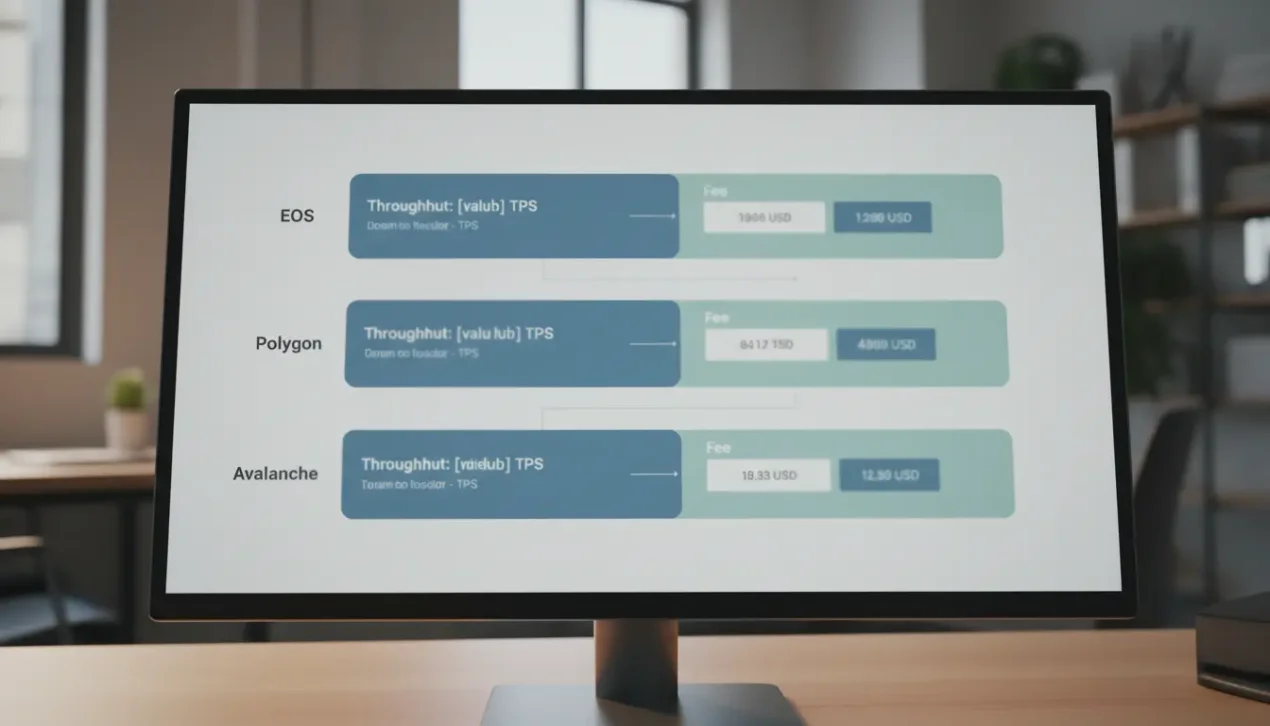
Why Sportsbook Contracts Scatter Across Chains
A developer I worked with in 2022 told me he’d chosen his chain “like picking a pub — wherever the regulars were.” He wasn’t being flippant. Where the users already live determines where sportsbook contracts get deployed, and the users scattered across half a dozen chains over the last decade based on fees, throughput, speculative token waves, and the occasional major outage on some rival. The resulting landscape is messy for a reason.
Every chain has its own tradeoffs, and a smart-contract sportsbook’s structural properties inherit directly from the chain beneath it. EOS sportsbooks operate on fundamentally different throughput economics from Polygon sportsbooks. Avalanche sportsbooks make different trust assumptions from both. A punter choosing between them is really choosing a tech stack, and the choice shapes the user experience more than the sportsbook’s branding ever does.
Before diving into specific chains, one conceptual check: this article covers smart-contract sportsbooks specifically — books where the betting contract is deployed on-chain and settlement happens programmatically. That’s a different category from centralised crypto sportsbooks that merely accept crypto deposits, and the architectural differences between those two categories are covered in the piece on DEX versus centralised crypto books. Everything below assumes you’re comparing across the on-chain class.
How they differ from ordinary books is in DEX versus centralised.
EOS Sportsbooks: Early Movers, Governance Legacy
EOS was the first chain to host production smart-contract sportsbooks at scale, starting around 2018-2019. The early movers chose it for good reasons that mostly still apply: very low per-transaction fees, sub-second block times, and a delegated-proof-of-stake governance model that made deploying gambling contracts genuinely feasible when Ethereum’s gas fees made equivalent deployments prohibitive.
The EOS sportsbook architecture typically involves a main betting contract that holds liquidity, a settlement contract that resolves markets, and a governance contract that manages fee distribution and protocol changes. Users sign transactions with their EOS wallet, bets are placed against the pool, and winning bets trigger automatic payouts. The entire flow happens on-chain within a single block in most cases.
Legacy EOS sportsbooks retained a governance-token model that looks quaint by 2026 standards. Token holders vote on protocol parameters — minimum stake, fee percentages, oracle choice — and in some cases share in the protocol’s revenue through a staking mechanism. The token-holder governance has delivered mixed results: sometimes it’s produced sensible upgrades, sometimes it’s been captured by a small group of large holders, and occasionally it’s frozen meaningful updates because consensus was impossible to reach.
The user experience on EOS is fast and cheap but UI-dated. The platforms built in 2018-2019 generally haven’t been rebuilt, and they feel their age. Newer chains have caught up on fee economics while providing modern tooling, and EOS sportsbook volume has gradually migrated. The remaining EOS-based operators are typically serving a niche audience that values the specific governance model or the lower regulatory attention the chain receives.
What’s worth knowing if you’re betting on EOS today: the chain itself is operationally stable but has experienced governance controversies that have affected user confidence over time. Smart contracts deployed years ago are battle-tested but also frozen at their deployment time’s design choices, which don’t always reflect current security best practices. Verify the specific book’s contract audit history rather than trusting “EOS reputation” as a proxy.
Polygon Sportsbooks: L2 Throughput, USDC Liquidity
Polygon became the dominant chain for smart-contract sportsbooks during 2023-2025 for reasons that add up cleanly: Ethereum compatibility at a fraction of the fees, meaningful DeFi liquidity, and first-class USDC support that lets books denominate bets in a stable asset users already hold. Layer 2 solutions overall are expected to cut crypto-gambling fees by approximately 90 per cent compared to L1 rails, and Polygon has been the best production example of that thesis at sportsbook scale.
The technical advantage is measurable. A typical sportsbook bet placement on Polygon costs roughly A$0.05 to A$0.30 in gas depending on network conditions. The same bet placement on Ethereum L1 would cost A$8 to A$40. That 100-200× cost differential makes retail-stake betting economic on Polygon that simply isn’t economic on L1. The throughput also allows for responsive live-betting UIs that would be prohibitive on Ethereum L1.
USDC support is where Polygon sportsbooks really distinguish themselves from EOS-era predecessors. Users can bet directly in USDC without bridging to a volatile asset first. The operator holds USDC liquidity pools, pays out in USDC, and can integrate cleanly with other DeFi protocols on Polygon for liquidity management. The user gets a price-stable betting experience with the programmability of a smart contract.
Polygon’s governance and security are generally robust. The chain uses a proof-of-stake consensus with meaningful validator decentralisation, and the bridge architecture connecting Polygon to Ethereum mainnet is battle-tested by years of production use. Smart-contract sportsbook operators deploying on Polygon benefit from the extensive developer tooling and audit infrastructure that Ethereum compatibility provides — the same auditors who check Ethereum contracts can check Polygon contracts.
The downsides are subtle but real. Polygon bridges have had security incidents affecting individual tokens, and users bridging large amounts to or from the chain should be aware of bridge-specific risks. Polygon’s long-term positioning among Ethereum L2s has been contested — zkEVM variants, Optimism, Arbitrum, and Base all compete for similar developer mindshare, and book longevity on any specific L2 depends partly on that L2’s ongoing relevance. A sportsbook that deployed only on Polygon and doesn’t maintain multi-chain presence is exposed to chain-specific platform risk.
Avalanche and Other EVM Alternatives
Avalanche occupies a specific niche in the smart-contract sportsbook landscape: high throughput, fast finality, and a multi-chain architecture that lets operators choose between subnet deployment and core chain deployment depending on their requirements.
The Avalanche core C-Chain runs EVM-compatible smart contracts with sub-second finality and fees typically in the A$0.10 to A$1 range. That’s more expensive than Polygon on a per-transaction basis but faster to finality, which matters for live-betting contracts that need to resolve bets before the next event in a match. The faster finality lets Avalanche-based books offer live-betting UX that competes with centralised books in responsiveness.
Avalanche subnets add a dimension not present on most other chains. A sportsbook can deploy its own subnet — a parallel blockchain with custom economics — giving it control over validator set, fee structure, and even consensus parameters. Subnets are expensive to operate but offer operational isolation from broader chain congestion. A few DEX sportsbook operators have experimented with subnet deployments to create bet-specific execution environments.
Beyond Avalanche, the other EVM chains worth mentioning briefly: BNB Chain hosts several smart-contract sportsbooks, usually focused on Asian markets, with very low fees but meaningful regulatory exposure due to the chain’s centralised validator model. Fantom hosts a small cluster of on-chain books with niche audiences. Base, Coinbase’s L2, has grown fast during 2024-2025 and now hosts a few credible sportsbook deployments. Arbitrum has broad DeFi integration but relatively few pure-play sportsbook contracts.
Multi-chain deployment has become table stakes for serious smart-contract sportsbook operators. A single book might deploy on three or four chains simultaneously, letting users bet from whichever chain their assets already live on. The operational complexity of maintaining multi-chain liquidity is meaningful, but the user acquisition benefit of meeting users where they already are outweighs it for serious operators.
Chain Comparison: Fees, Speed, Trust Assumptions
Let me put the practical comparison into a usable frame. Fees first, because that’s what punters feel most immediately.
EOS: typically sub-A$0.01 per transaction, sometimes effectively zero through staking bandwidth. Cheapest of the four chains compared here.
Polygon: A$0.05 to A$0.30 per transaction in typical conditions. Cheap enough that retail stakes make sense. Layer 2’s approximately 90 per cent fee reduction versus Ethereum L1 shows up most clearly at this scale.
Avalanche: A$0.10 to A$1 per transaction. More expensive than Polygon but still comfortably below any L1 rail.
For reference, Ethereum L1 is typically A$8 to A$40 per sportsbook transaction, which is why pure L1 smart-contract sportsbooks don’t really exist anymore at retail scale — the economics just don’t work.
Speed. EOS finalises in under a second. Avalanche in 1-2 seconds. Polygon in 2-3 seconds. Ethereum L1 in 12-30 seconds depending on finality assumptions. For live betting, EOS and Avalanche feel more responsive; Polygon is acceptable; L1 is functionally unusable.
Trust assumptions differ more than fee and speed comparisons suggest. EOS relies on 21 block producers elected through token-weighted voting, which is more centralised than a proof-of-stake chain with thousands of validators. Polygon uses a 100-validator proof-of-stake consensus with a bridge to Ethereum mainnet that adds trust dependency on the bridge’s security. Avalanche uses a novel consensus with a 1,000+ validator set on the C-chain, though subnets have their own validator sets chosen by the subnet operator.
Which trust model matters most to you depends on what you’re protecting against. If you worry about state censorship of transactions, chains with more decentralised validator sets are safer. If you worry about bridge exploits, chains without bridge dependencies are safer. If you worry about operator collusion with validators, EOS’s small validator set is a concern. No chain optimises for all these risks simultaneously.
The user-facing recommendation I give: match the chain to your typical stake size and betting style. Retail bettor doing modest weekly action — Polygon is the default choice, broad support, cheap fees, familiar tooling. Live-betting focus with small stakes — Avalanche if your book supports it, fast finality is worth the small fee premium. Exotic token holdings or specific governance-token interests — check what chains support the operators that let you interact with your existing holdings without bridging. Bridging fees and risks routinely eat the benefit of moving to a marginally cheaper chain.
Does a DAO-governed sportsbook mean no custodial risk?
Not exactly. A DAO-governed sportsbook has distributed operator control rather than absent operator control — a committee of token holders makes decisions about the protocol. That distribution improves against the risk of a single bad actor seizing user funds, but introduces governance-capture risk where a large token holder or coordinated group can vote through changes that disadvantage users. Custody risk shifts rather than disappears.
Are governance tokens useful to actual bettors, or just to holders?
Usually more useful to holders than bettors. Governance tokens typically confer voting rights and sometimes revenue shares, which are financially meaningful if you hold enough to matter. For a user who just wants to place bets, the token is irrelevant to the betting experience. Some sportsbooks add utility features — fee discounts for stakers, preferred customer status for larger holders — that bridge the gap, but the baseline position is that governance tokens are investment products, not betting products.
Why do some smart-contract sportsbooks still require a web login?
Because the smart contract handles settlement but not everything else. User interface, customer support, promotional offers, KYC where applicable, and complex market listings all live off-chain and need user accounts to function. The wallet connection handles the on-chain betting; the web login handles everything else. A fully on-chain experience without any off-chain user system is rare and typically comes with a much more primitive UX than the hybrid model.
Created by the "" editorial team.The wider context sits in our data-driven guide to Bitcoin betting.