
Random Number Generation in Crypto Betting: Oracles and VRFs
 Available in AU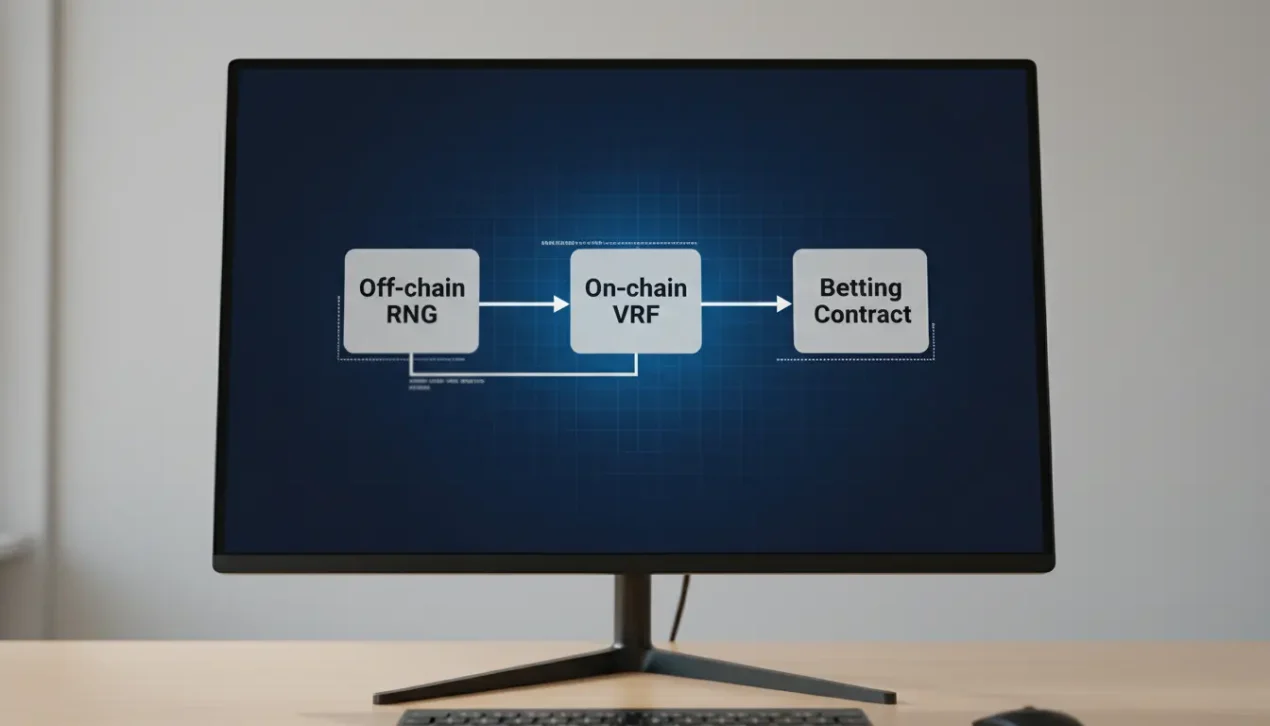
Why Randomness Is the Quiet Core of Crypto Betting
Most punters spend zero time thinking about where the randomness in their bets actually comes from. That’s fine until you lose three coin-flip markets in a row and start wondering. The question of how a crypto sportsbook generates the number that decides whether the next card is a seven or a king, or which team gets the next random bonus in a prediction market, is the single most boring and most important thing about the product you’re using.
In traditional online gambling, randomness is generated by a certified server-side algorithm and audited by licensed testing labs like eCOGRA or iTech Labs. The black box is the server, the audit is external, and trust flows through the regulator. In crypto gambling, the architecture is more varied — some books replicate the traditional model, others use verifiable on-chain randomness that removes the operator’s ability to manipulate outcomes without detection. Understanding which model your book uses matters, because the attack surfaces are different.
This article sits downstream of provably fair, which covered the commit-reveal scheme for proving an operator didn’t change their mind about an outcome after seeing your bet. Provably fair answers “did the operator tamper?” This article answers a different question: “where did the random number come from in the first place?” The two concepts are related but distinct, and conflating them — which most crypto marketing does — leaves you thinking you understand something you don’t.
What the proof actually shows is in provably fair betting.
Off-Chain RNG: Server-Side Entropy and Its Audit Trail
The classical model, still dominant on centralised crypto sportsbooks: random numbers are generated server-side by a certified RNG module, and the output is committed to a hash before the player interacts. This is how most of what calls itself “provably fair” actually works under the hood.
The server’s entropy source matters. Good implementations use a hardware random number generator — a physical device that samples noise from a quantum source, thermal fluctuations in a semiconductor junction, or similar physical randomness. Hardware RNGs produce high-quality entropy that’s genuinely unpredictable at the bit level. Software-only RNGs using pseudo-random algorithms seeded from system time or process state are theoretically crackable if the seed is recoverable, which is a non-trivial attack surface.
Certification regimes vary by licensing jurisdiction. Books licensed under the Curaçao LOK framework face RNG-testing requirements in their audit cycle. Maltese and UK-licensed operators have more stringent ongoing testing with specific statistical tests for bias. Books operating without meaningful licensing run whatever RNG they choose with whatever auditing they choose, which — in the honest case — is often none.
The audit trail you can actually see as a player is the commit-reveal hash and the verification tool. The server generated a seed, committed to its hash before you played, and revealed the seed after. You can verify the commitment but you can’t verify the entropy source. The operator could, in principle, be using a biased RNG that happens to produce more losses than a fair one would, and the commit-reveal audit would never catch it — because the audit only checks consistency, not statistical fairness of the underlying distribution.
This is where external testing services come in. The 48 per cent of blockchain-gaming platforms that implemented AML and KYC protocols in 2025 largely did so at licensed operators that also subject their RNG to third-party statistical testing. Unlicensed books typically don’t. As a player, the existence of published RNG test reports from a recognised lab is a meaningful signal of operational seriousness.
On-Chain VRF: How Chainlink-Style Randomness Works
Verifiable random functions solve a problem that server-side RNG can’t: how do you generate randomness for an on-chain contract in a way that neither the operator nor the miners can manipulate? The answer involves cryptographic commitments from an external source, verified mathematically on-chain.
Chainlink VRF is the most widely deployed implementation, and it works roughly like this. The smart contract requests a random number, sending a small fee. A Chainlink oracle receives the request, generates a random number using its private key and a public seed derived from the blockchain state, and returns both the number and a cryptographic proof. The smart contract verifies the proof on-chain using Chainlink’s public key, and if the proof checks out, the random number is used for the bet resolution.
The security property here is that the oracle cannot select which random number to return. The VRF algorithm is deterministic given the oracle’s private key and the input seed — the oracle can’t “try again” for a different number without the attempt being visible and rejectable. The operator can’t pay the oracle to produce a favourable number because the oracle literally cannot do so without breaking its cryptographic commitment.
What VRF doesn’t solve. The oracle service itself could go offline, become censored, or have its private keys compromised. Multiple oracle services with independent keys running in parallel reduce this risk but don’t eliminate it. The seed that the oracle uses as input comes from the blockchain, and if an attacker can manipulate block timing or content in a specific way, they could in theory influence which seed was available when — this is a subtle attack surface that has been the subject of academic research, but practical exploits against production Chainlink VRF are vanishingly rare.
For a DEX sportsbook using VRF, the randomness pipeline is genuinely trust-minimised. The operator can’t cheat because they don’t generate the random number. The oracle can’t cheat because the cryptography is verifiable. The miners can’t cheat because the VRF input is locked in before the requested block is mined. The user can verify all of this themselves by reading the transaction trace on-chain.
Oracle Risks and Known Attack Surfaces
Oracle-based systems have attack surfaces that don’t exist in purely server-side RNG, and the crypto-gaming ecosystem has seen real exploits over the years that are worth understanding.
The most documented attack class is oracle-delay manipulation. If an attacker controls enough of the blockchain’s mining or transaction ordering capacity, they can potentially delay or front-run oracle updates in ways that let them see the random number before placing a bet, or place a bet and then influence which random number gets used. These attacks are expensive and detectable, but they’ve been demonstrated in controlled environments on less-well-designed oracle systems.
Flash-loan attacks combined with oracle manipulation have hit DeFi protocols repeatedly since 2020. The pattern adapts to gambling contracts as well — an attacker borrows enough capital briefly to move an oracle price or delay an oracle response, exploits the temporary distortion, and repays the loan, all within a single transaction. Well-designed gambling contracts avoid price-based oracles and rely solely on randomness oracles, which reduces but doesn’t eliminate this attack class.
Blockhash-based randomness is the historical failure mode that taught the industry to stop using it. Early on-chain betting contracts used the hash of a future block as their source of randomness, reasoning that the hash couldn’t be known in advance. This was wrong. Miners can choose which transactions to include in their block, and a mining miner betting against their own block’s hash can selectively reject blocks whose hash would cause them to lose. The attack was demonstrated in practice multiple times in 2018-2019 and caused real losses. Any 2026 sportsbook still relying on blockhash randomness has a serious problem.
Pre-image leakage is the subtlest attack. If the operator generates the server seed and retains it in any form that’s recoverable — even a backup file, even a logged debug statement, even a memory dump — an attacker who compromises the server can in theory recover past seeds and retroactively reconstruct outcomes. This doesn’t let them change the past, but it lets them verify patterns in the RNG that should be private, which can be used to fingerprint future outputs.
The defensive posture at a competent crypto sportsbook: cryptographically sound randomness source, public commitment before play, rotation of server seeds at frequent intervals, zero retention of seeds after reveal beyond what’s needed for verification. Books that can’t explain this pipeline in a sentence or two shouldn’t be trusted with large stakes.
What a Bettor Can Verify Without Reading Contracts
You’re not going to read the source code of your sportsbook’s randomness infrastructure. Realistically nobody does. What you can do is look for signals that distinguish serious implementations from theatrical ones, and the signals are mostly boring but reliable.
Signal one: public verification tooling that works end-to-end. The book provides a tool where you input your bet parameters and the revealed server seed, and the tool reproduces the outcome. Verify a couple of recent rounds. If the tool works and produces matching results, the commit-reveal layer is intact. This is the provably-fair check I’ve covered in depth in the dedicated article on provably fair betting.
Signal two: published RNG certification. For licensed operators, look for references to eCOGRA, iTech Labs, GLI, or BMM Testlabs certifications in the footer of the site. These aren’t bulletproof — certifications are point-in-time audits, not ongoing guarantees — but their presence is a meaningful operational signal. Their absence on a book claiming “provably fair” randomness should prompt questions.
Signal three: published oracle choice for DEX sportsbooks. On-chain books should disclose which oracle service generates their randomness — Chainlink VRF, Pyth, API3, or something else. The disclosure should identify the specific oracle contract address and the verifiable relationship between the randomness request and the outcome. If a DEX book is opaque about its randomness pipeline, that’s a red flag regardless of how slick the UI looks.
Signal four: seed rotation frequency. On a commit-reveal system, the server seed should rotate frequently — at least once per session, ideally once per round for high-stakes markets. If the same server seed commitment covers weeks of play, the operational risk from a seed compromise compounds. The reveal page of a well-run book will show the seed rotating at observable intervals.
Signal five: transparent response to detected issues. Every RNG implementation has edge cases. The honest test is how the book responds when a user reports an anomaly. Quick acknowledgement, investigation, and published postmortem is the good pattern. Deflection, silence, or quiet reversal of contested bets is the bad pattern. You won’t see this directly until something goes wrong, but forum archives and public complaint patterns are a leading indicator.
Is blockhash-based RNG ever actually safe for a sportsbook?
No, not in any modern design. Blockhash can be manipulated by miners who have economic incentive to do so, and the attack has been demonstrated in practice on early on-chain betting contracts. Any current sportsbook using blockhash as its randomness source either is unaware of the problem or is relying on attack cost rather than cryptographic correctness. Neither is acceptable for a book taking significant stakes.
Can an operator see the VRF output before the bettor does?
For properly implemented VRF services, no. The oracle generates the random number deterministically from inputs that are known to both sides, and the output is revealed simultaneously on-chain. The operator receives the result at the same block as anyone else watching the contract. The only scenarios where this breaks involve compromise of the oracle itself, which is a different class of problem from operator-level cheating.
Does Ethereum’s RANDAO change anything for sports markets?
Marginally. RANDAO provides an on-chain entropy beacon that validators contribute to, giving smart contracts a source of randomness that doesn’t require an external oracle. For betting contracts, RANDAO can be used as an entropy input alongside or instead of VRF. The security properties are similar in the honest case, different in the attack case — manipulating RANDAO requires a large fraction of validator stake, while manipulating a VRF service requires compromising the oracle. Neither is trivial.
Created by the "" editorial team.The wider context sits in our data-driven guide to Bitcoin betting.