
Live (In-Play) Bitcoin Betting: Latency, Limits and Cash-Out Rules
 Available in AU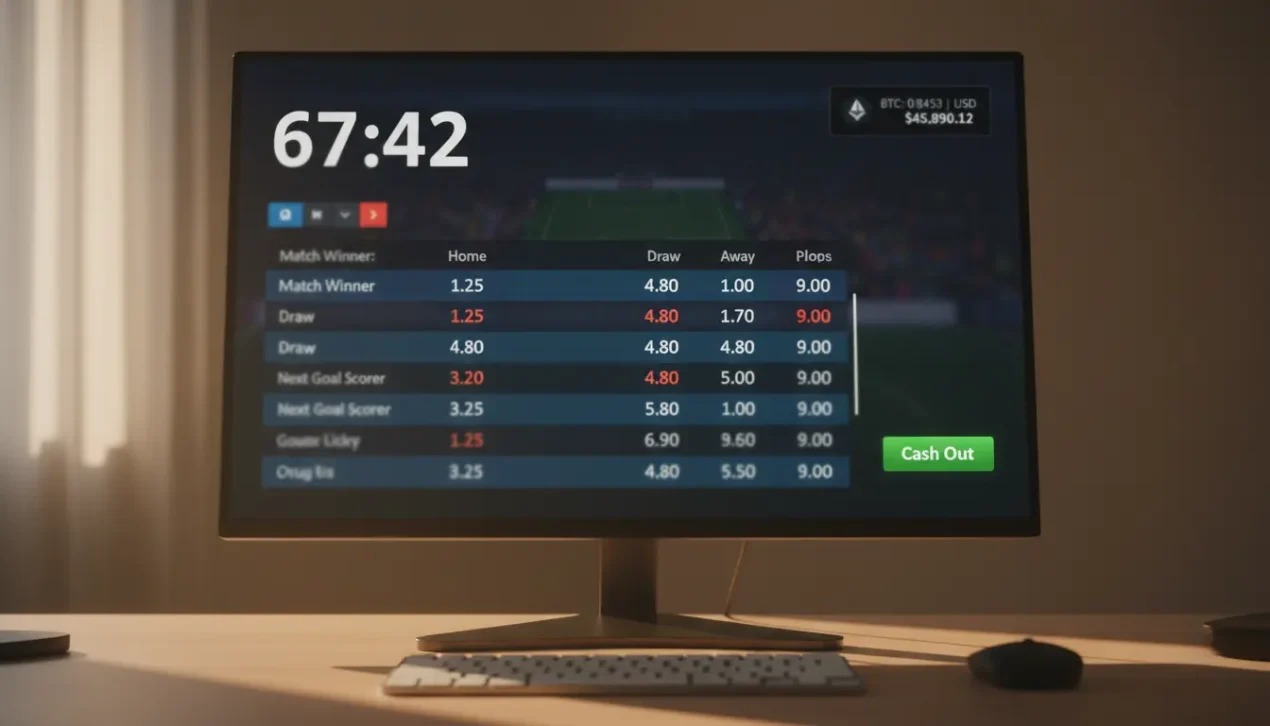
What Changes When the Match Is Already Running
Pre-match betting is a library. Live betting is a trading floor. The same bettor who spends 20 minutes researching a weekend multi will, 30 seconds into a live A-League match, hammer a market they haven’t looked at in 18 months because something just happened on the pitch. That behavioural shift is exactly what live markets are engineered to exploit, and it’s why understanding the mechanics matters more here than anywhere else in sports betting.
Three things change structurally the moment a match starts. Odds move continuously instead of sitting still. Limits compress relative to pre-match. Cash-out becomes available, with a margin baked into every cash-out price. Every one of those changes favours the book if you’re not paying attention, and each one can favour the punter who is.
Crypto sportsbooks are particularly active in live markets because their audience skews towards fast-tempo betting. Mobile share is the evidence: about 64 per cent of crypto iGaming bets happen on mobile devices, and the projection is that 80 per cent of crypto gambling will be mobile by 2026. Mobile is where live betting happens — nobody opens a laptop mid-match. The whole crypto-betting stack is optimised for someone watching a match on one screen and tapping bets on a phone held in the other hand.
Instant funding needs the Lightning Network.
The Latency Chain: Feed, Book, Browser, You
Understanding latency is the single most important thing in live betting, and most punters never think about it. There isn’t just “the game” and “the odds.” There’s a chain of delays between the thing that happens on the pitch and the moment your bet hits the book, and each link in the chain has implications.
Link one: the event happens. Goal, try, wicket, first-blood kill, whatever. Time zero.
Link two: the event is captured by the data provider. Depending on the sport and the provider, this is anywhere from half a second (machine-read from an API, esports-style) to eight seconds (human scorer tapping a keyboard at the venue) after the event.
Link three: the data provider pushes the update to the sportsbook. Typically under a second for modern feeds.
Link four: the sportsbook’s trading engine re-prices the affected markets. Takes milliseconds to a second or two depending on market complexity and the book’s tech.
Link five: the new odds are pushed to your browser or app. This is where mobile network quality starts mattering a lot. On 5G with the app as foreground, maybe 200 to 500 milliseconds. On congested WiFi at the pub, 2 to 5 seconds.
Link six: you see the odds, decide to click, and the click travels back to the book. Your reaction time is typically 500 to 1500 milliseconds. The network round trip adds another 200 to 500.
Add it up and the gap between an event on the pitch and your bet landing on the book is easily 3 to 8 seconds in normal conditions, longer on bad networks. Meanwhile the broadcast you’re watching is typically delayed 30 to 90 seconds behind live for TV, and 8 to 15 seconds behind for most streaming apps. The book’s data is fresher than your broadcast. If you think you just spotted a juicy mispriced line after something happened in the match, the book saw it first — usually before you even saw the event.
Stake Caps and Suspended Markets in Live BTC Betting
Live markets look like they have the same infinite liquidity as pre-match. They don’t. Two mechanisms tighten the screws on live punters, and both happen quietly unless you know to look for them.
Stake caps compress dramatically in-play. A pre-match max of 0.5 BTC on an A-League full-time result might drop to 0.05 BTC once the match is live, and to 0.01 BTC in the final 10 minutes when the outcome distribution is narrow. Books do this because their pricing is less confident in-play — they’re working off a model that’s chasing live data — and because in-play is where sharp money tries to exploit latency arbitrage. The cap is a risk-management tool, not a courtesy.
Market suspensions kick in whenever anything material happens. Goal scored, red card, penalty awarded, video referee call in progress, a Dota 2 Roshan fight starting — the market gets greyed out for seconds to a minute while the book’s traders reassess. If you clicked during the suspension and the market suspends before your bet was accepted, the bet is rejected. The stake stays in your account. This is annoying if you were trying to catch a price move, and it’s exactly how the book is designed to work.
What I’ve seen frustrate newer live bettors: late-match limits. In the final 5 to 10 minutes of a tight match, the books crush their limits because a single goal can flip the outcome, and the outcome distribution is heavily bimodal. A A$200 max pre-match becomes a A$20 max at minute 87. This isn’t the book trying to rip you off; it’s the book refusing to take unlimited risk on a coin flip that resolves in minutes.
For BTC-specific quirks, the rules are the same as for fiat in-play — no special crypto advantage. Anyone selling you “instant unlimited live BTC betting” is selling you a fantasy. The margin comes from elsewhere.
Cash-Out: The Formula and Its Hidden Margin
Cash-out is the single most mis-understood feature in live betting. Let me explain the math, because once you see it, you’ll understand why I almost never use it.
The idea is simple: you’ve placed a bet pre-match, the situation has moved in your favour, and the book offers to buy out your bet early at some price. You take the cash-out, you lock in a guaranteed amount, you skip the rest of the match. Sounds great. The hidden side is that the cash-out price always includes a margin on top of the fair value — typically somewhere between 5 and 15 per cent depending on the book and the market.
The math. Say you bet 0.01 BTC on Team A at decimal odds of 3.00. Pre-match, your position’s expected value — if the book’s odds are fair — equals the stake, so about 0.01 BTC. Team A goes up early. The book’s current price on Team A is now 1.50 decimal. The fair value of your original bet at this moment is the stake times original odds divided by current odds: 0.01 × 3.00 / 1.50 = 0.02 BTC. That’s what your position should be worth if the book’s current odds are honest.
What cash-out pays you is 0.02 BTC minus the cash-out margin. A typical cash-out offer here might be 0.0175 BTC — about 87 per cent of the fair value. The 13 per cent gap is pure book margin on top of the vig you already paid in the original bet. You’re effectively betting twice: once on the original outcome, once on the book’s cash-out pricing being fair (which it isn’t).
The only scenarios where cash-out is mathematically justified are ones where you genuinely can’t monitor the rest of the match and the stake is meaningful. “I’m heading into a meeting and I can’t watch the final 20 minutes and I don’t want to check my phone for updates” is a legitimate reason. “The bet is looking good and I want to lock it in” is not — you’re paying a tax on your own impatience. Cash-out feels like a courtesy; it’s a product with a margin you consent to pay. If this math applies more broadly to how different books present their margins, I’ve got a separate explainer on mobile Bitcoin betting and small-screen UX that covers how cash-out surfaces on touch screens specifically.
Live Betting Discipline When Stakes Are in Sats
Live betting produces the worst stake-sizing discipline I see in my community, and crypto makes it slightly worse. Let me explain the specific failure mode.
When you’re staking in BTC or sats, the mental accounting is broken. “5,000 sats” doesn’t feel like “A$3.50” — it feels like an abstract gamer-chip count. “0.001 BTC” doesn’t feel like “A$70” — it feels like a small decimal number. I’ve watched experienced punters who’d never put A$300 on a pre-match market without modelling it first, happily fire 0.004 BTC on an in-play corner kick because the number looked smaller than their brain registered.
The first discipline rule I give any live bettor: mentally convert every BTC stake into the fiat equivalent before clicking. It’s annoying, and it’s the single habit that has saved me the most money across my career.
The second rule: set a live-session stake cap before the match starts, denominated in fiat, and treat it as inviolable. Something like “I will not live-bet more than A$100 total during this match, regardless of how the match goes.” The book’s own deposit limit is a bad guardrail because live betting eats through it fast — your own rule, set when you were rational, is the only one that matters when you’re down 2-0 in the 70th minute and looking for a desperate recovery.
The third rule is the hardest. Don’t live-bet matches you have no prior opinion on. Live markets are designed to reward punters who came in with a model and catch favourable price moves from it. Punters who arrive at the match with no pre-existing view, pick a side based on vibes in the 30th minute, then chase it with progressively wilder stakes — this is the modal losing live bettor. The book is making most of its margin from this profile.
Micro-stake culture on Lightning has created a new wrinkle: betting in 500-sat increments feels costless, but forty 500-sat bets is still 20,000 sats. Small stakes aggregate fast when the tempo is fast. Keep an eye on cumulative stake, not just per-bet stake.
Does a BTC bet freeze if the market suspends after I click?
If the suspension hits the book before your bet was accepted, the stake is returned to your balance and the bet never existed. If your bet was accepted and then the market suspends, the bet stands at the odds you got. You’ll know immediately — the book returns a confirmation with a bet ID if it took, or a ‘bet rejected’ message if it didn’t. Don’t assume anything in between; refresh your bet history to confirm.
Is cash-out ever mathematically fair to the bettor?
Essentially never on a major sportsbook. The cash-out margin is structural and usually sits between 5 and 15 per cent on top of the vig you already paid. A ‘fair’ cash-out would return exactly the implied value at current odds with zero additional margin, and no commercial book offers that. The only justification for cashing out is that you can’t or won’t monitor the rest of the match, and you value certainty over expected value.
Why do live BTC limits drop late in a match?
Because the outcome distribution compresses and a single event can flip the result instantly. A book taking a large stake at 1.20 odds in the 88th minute is essentially being asked to pay 5 to 1 on a coin flip, which is a risk profile no book will accept without tiny limits. The drop is a function of model uncertainty, not a reaction to your specific account.
Created by the "" editorial team.The wider context sits in our data-driven guide to Bitcoin betting.