
Reload Bonuses and VIP Programs on Crypto Sportsbooks
 Available in AU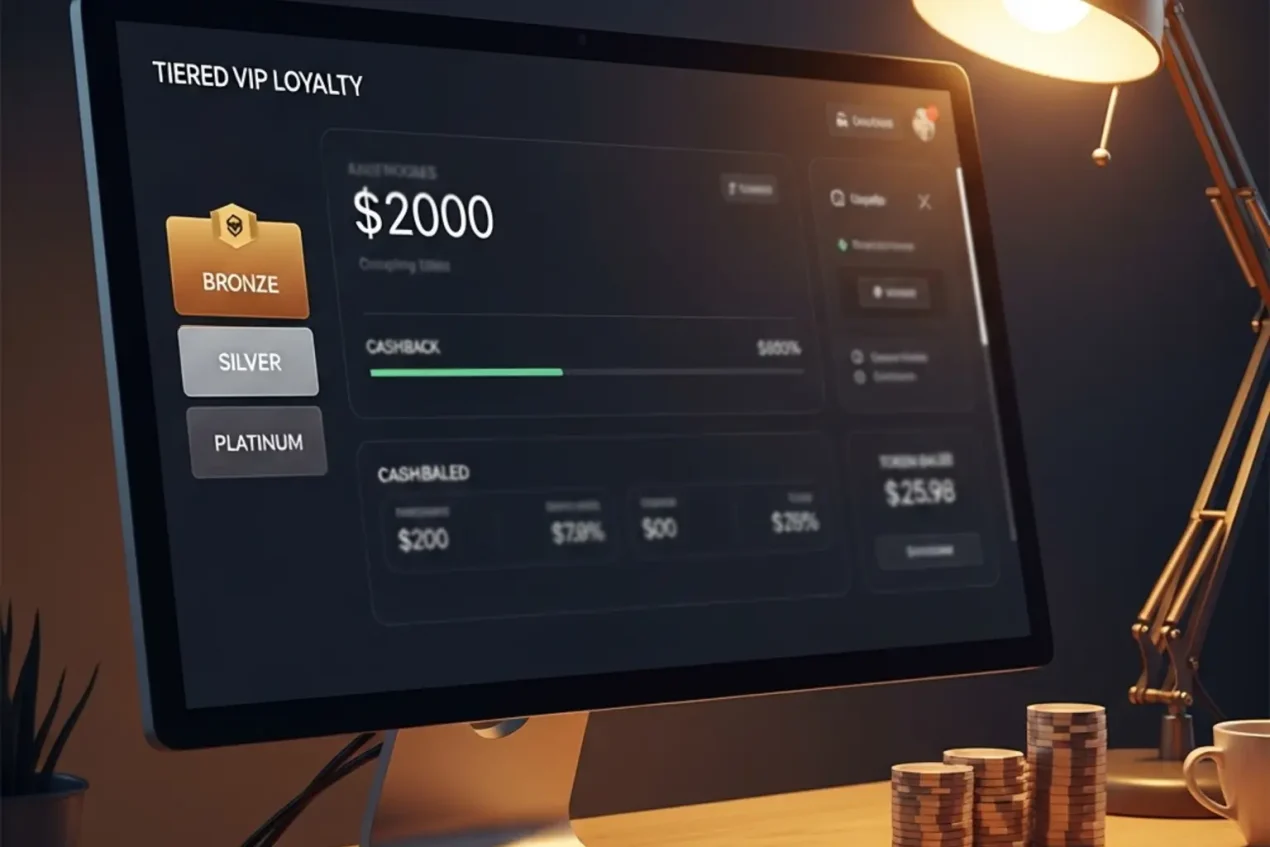
Why Ongoing Bonuses Matter More Than the Welcome Offer
The welcome bonus gets all the marketing. The reload program and VIP tiers quietly determine whether a long-term crypto bettor actually comes out ahead. I watched a reader in Adelaide methodically track his activity at a mid-tier crypto sportsbook for six months. His welcome bonus was worth about A$180 in true EV after rollover. His ongoing reload and cashback collections over the next 24 weeks totalled about A$1,100. That 6× gap between welcome and ongoing is the pattern at most operators, and it’s why understanding the structure of ongoing bonuses is more important than chasing the highest welcome offer.
The industry has figured this out too. 58 per cent of respondents to the SOFTSWISS iGaming Trends 2025 survey named cryptocurrency as the main driver of growth in new markets, and part of what’s powering that growth is exactly this recurring-engagement engineering. Operators aren’t leaving their biggest-margin customers alone — they’re building retention programs designed to keep those customers betting across months rather than chasing new acquisitions every weekend.
The underlying economics explain the architecture. Acquiring a new crypto bettor costs an operator somewhere between US$80 and US$400 depending on the channel. Retaining an existing bettor through ongoing bonuses costs a fraction of that, and the existing bettor’s expected lifetime value is typically 3-10× higher than a one-time welcome bonus user. Reload programs are where operators actually make the economics work, and where bettors who understand the structure genuinely do better over time than bettors who don’t.
Rollover maths is worked through in bonuses and bankroll.
Anatomy of a Weekly Reload
A typical weekly reload bonus works like this. You deposit during a specified window (usually Sunday-to-Thursday on most crypto books, occasionally tied to specific sporting events). The book matches some percentage of your deposit — typically 10-50 per cent — as a bonus. The bonus has a rollover requirement: you have to wager the bonus amount some multiple of times, at qualifying odds, before it converts to withdrawable balance.
Let me walk through a realistic example. The book offers a 20 per cent weekly reload up to 0.005 BTC. You deposit 0.01 BTC, so the bonus is 0.002 BTC (20 per cent of your deposit, capped at 0.005). Rollover is 5× the bonus at odds of 1.70 or higher. You need to wager 0.01 BTC total (5 × 0.002) on qualifying bets before the bonus becomes withdrawable.
The EV calculation. At a 5 per cent hold on the qualifying markets, wagering 0.01 BTC produces an expected loss of 0.0005 BTC on the rollover itself. Your bonus was 0.002 BTC. Your expected net value from the bonus is 0.002 minus 0.0005 = 0.0015 BTC, or about 75 per cent of the nominal bonus amount. That’s actually decent — you’re capturing three-quarters of the headline number as real EV.
Contrast with a welcome bonus. A 100 per cent welcome match up to 1 BTC with 10× rollover on the bonus at 1.70+ sounds much more generous. Run the math: 10× of 1 BTC is 10 BTC wagered, at 5 per cent hold expected loss is 0.5 BTC, minus your 1 BTC bonus leaves you with net 0.5 BTC — nominally 50 per cent of the headline. But the terms often apply the rollover to the combined deposit-plus-bonus, doubling the effective wager requirement, which halves the EV again to around 0 net. Welcome bonuses headline generously and deliver poorly.
Reload bonuses are usually cleaner because the rollover multiples are smaller and the percentage matches are modest. A 20-30 per cent reload with 5× rollover is often delivering 70-80 per cent of its nominal EV. A 100 per cent welcome with 10× rollover is often delivering 0-30 per cent.
The specific variables worth checking before opting in: the match percentage, the cap on the match, the rollover multiplier, the minimum qualifying odds, which markets count towards rollover, and the time limit to complete rollover. Any of these can make or break the EV. “100 per cent match up to 1 BTC” means nothing without knowing the rest.
VIP Tiers: How Points Become Real Value (or Don’t)
VIP programs layer on top of reload bonuses and add ongoing value for engaged users. The structure is usually tier-based: the more you wager, the higher your tier, and higher tiers unlock better ongoing benefits.
Points accumulation. Every wager earns points at a rate that depends on the market type and your current tier. Main-line sports bets typically earn fewer points per dollar wagered than casino-style games; props and parlays often earn more because the book’s margin is higher and they can afford to give more points back. A typical rate is 1 point per A$10-A$25 of qualifying wager on sports.
Tier progression. Accumulated points advance you through named tiers — Bronze, Silver, Gold, Platinum, Diamond, or whatever the book’s cosmetic labels are. Each tier has progression requirements (cumulative points) and maintenance requirements (points per month to avoid tier downgrade).
Tier benefits typically include: weekly reload bonus percentage increases with tier, higher cashback rates, faster withdrawal processing, lower minimum withdrawal thresholds, access to tier-restricted bonuses, personal VIP host contact for higher tiers, and sometimes cosmetic perks like custom avatars or site themes.
The value dispersion across tiers is stark. A Bronze-tier user might see 5 per cent cashback on weekly losses. A Diamond-tier user might see 25 per cent cashback plus accelerated withdrawal plus dedicated support. The value differential is genuinely large, and it scales with how much the user wagers. Stake.com’s position in the industry — with estimated valuations ranging from US$14 billion to US$23.5 billion depending on the source — rests heavily on the retention economics of their VIP program. The book makes most of its money from a small fraction of users, and those users are kept happy with tier benefits that would be economically ruinous to offer universally.
What to actually check. Look at the realised benefits of each tier, not the cosmetic descriptions. A “Gold” tier that offers 10 per cent cashback weekly up to A$500 is materially different from a “Gold” tier at another book offering 15 per cent cashback weekly uncapped. The labels don’t transfer across operators, but the specific benefits do, and comparing like-for-like benefits is the honest assessment.
Tokenised Loyalty: Real Asset or Marketing Dust
Some crypto sportsbooks have moved beyond traditional points systems to tokenised loyalty programs. Points are replaced with tradeable tokens that can potentially be used beyond the sportsbook itself. The industry trajectory is substantial: projections indicate that 80 per cent of crypto-gambling platforms will use tokenised loyalty systems by 2025.
The pitch is appealing. Your loyalty earnings are on-chain, transparent, transferable, and potentially valuable beyond the sportsbook’s own ecosystem. If the token has a market price, your loyalty has real economic value you can realise by selling the tokens.
The reality is more complicated. Most sportsbook loyalty tokens trade thinly on relatively obscure exchanges, with prices that fluctuate heavily based on marketing cycles and general crypto sentiment. A token earned at A$0.30 might trade at A$0.10 by the time you want to sell, or at A$0.60 in a bullish moment. The volatility creates a mark-to-market problem that traditional points systems don’t have — your traditional-points balance is worth whatever the book’s redemption schedule says it’s worth, while your token balance fluctuates.
The mechanism by which the token has any value is the real question. Some loyalty tokens have explicit redemption rights at the sportsbook — stake X tokens for Y benefits. These have floor value defined by the redemption utility. Other loyalty tokens are purely speculative assets whose value depends entirely on secondary-market demand from traders, not on any intrinsic utility at the sportsbook. Those tokens can go to zero if the sportsbook’s user base loses interest.
Transferability can be a real benefit or illusory. Tokens that trade on major exchanges are genuinely transferable — you can send them to any wallet and sell them anywhere. Tokens that only trade on the sportsbook’s own internal exchange or on small affiliated DEX pools are transferable in name only; liquidity is thin enough that any real sell-off would crash the price.
My general assessment after watching multiple tokenised loyalty launches: treat any token value as a bonus on top of the sportsbook’s intrinsic offer, not as a core benefit you’re relying on. If the sportsbook is worth betting at without the token, the token is upside. If the sportsbook is only worth betting at because of the token’s value, you’re making a speculative bet on the token rather than on sports, and the risk profile is entirely different.
Computing the Real EV of an Ongoing Program
Putting it together: how do you actually compare the long-run value of ongoing programs across different books? Here’s the calculation that matters.
Step one: estimate your monthly wagering volume at the book. Not what you hope it’ll be — what you’ve actually done over the last 3 months, or what you realistically plan to do. Be honest.
Step two: calculate expected monthly cashback at your tier. If the book offers 10 per cent weekly cashback on net losses and your expected monthly net loss is A$500, cashback delivers A$50 of monthly EV. If the cashback is capped, apply the cap.
Step three: add expected reload bonus value. If you typically make 3 qualifying deposits per month and the average reload EV is 75 per cent of a 20 per cent match on A$200 deposits, that’s 3 × 0.75 × 0.20 × 200 = A$90 of monthly EV.
Step four: add tier-specific benefits. Birthday bonus, tier-bonus at progression milestones, any other numeric benefits the book offers. Estimate them honestly — if you’ve never actually claimed a birthday bonus because you forgot, don’t count it.
Step five: subtract the opportunity cost. Any rollover requirement costs expected hold on the qualifying wagers. For reload bonuses I already accounted for this in the EV calculation. For cashback programs, no rollover typically applies — cashback comes as free money. For VIP benefits, assume the benefits you describe accurately.
Step six: compare against competitor books. A book with better cashback but worse reloads might net to similar monthly EV as a book with the reverse. Total EV is what matters, not individual components.
One final adjustment that matters. Bonuses feel abstract until you plug your actual betting pattern into them. A reader who typically bets A$50 per week will get very different value from a book optimised for A$500-per-week bettors than one optimised for his actual pattern. Match the book to your actual activity level; ignore books whose programs are clearly aimed at a different tier than yours. The house-edge math that underlies much of this — where hold concentrates, which markets carry what margin — is covered separately in the piece on reading the house edge and vig, and that arithmetic feeds directly into whether any specific program is actually worth chasing.
Are tokenised VIP rewards actually redeemable off-platform?
Depends on the specific token. Tokens that trade on major exchanges with real liquidity can be sold for other crypto and effectively converted to fiat. Tokens that only exist within the sportsbook’s own ecosystem are only redeemable at the sportsbook itself, even if they’re labelled as tokens. Before treating a tokenised reward as ‘real money,’ check whether it has any market price and whether you could actually sell meaningful quantities without crashing the price.
Do crypto cashback programs count towards rollover?
Usually no. Most cashback programs credit as bonus balance that requires its own rollover before becoming withdrawable, or as standard deposit-bonus funds subject to the normal rollover rules. Some books credit cashback as pure cash with no rollover — those are meaningfully more valuable and worth specifically looking for. Read the terms on any cashback program to confirm whether the cashback itself has wagering requirements.
Is rakeback on a sportsbook meaningfully different from rakeback in poker?
The underlying concept is similar — the operator returns a fraction of the vig you’ve paid through betting. The mechanics differ. Poker rakeback is calculated on the rake extracted from hands you’ve played. Sportsbook rakeback is calculated on the implied vig you’ve lost through losing bets or on total wagered amounts at a percentage rate. Sportsbook rakeback percentages are typically smaller than poker rakeback because sportsbook margins are smaller, so a 10 per cent sportsbook rakeback on 5 per cent vig bets is a 0.5 per cent net reduction in the house edge.
Created by the "" editorial team.The wider context sits in our data-driven guide to Bitcoin betting.