
Player Props and Alt-Lines on Bitcoin Sportsbooks
 Available in AU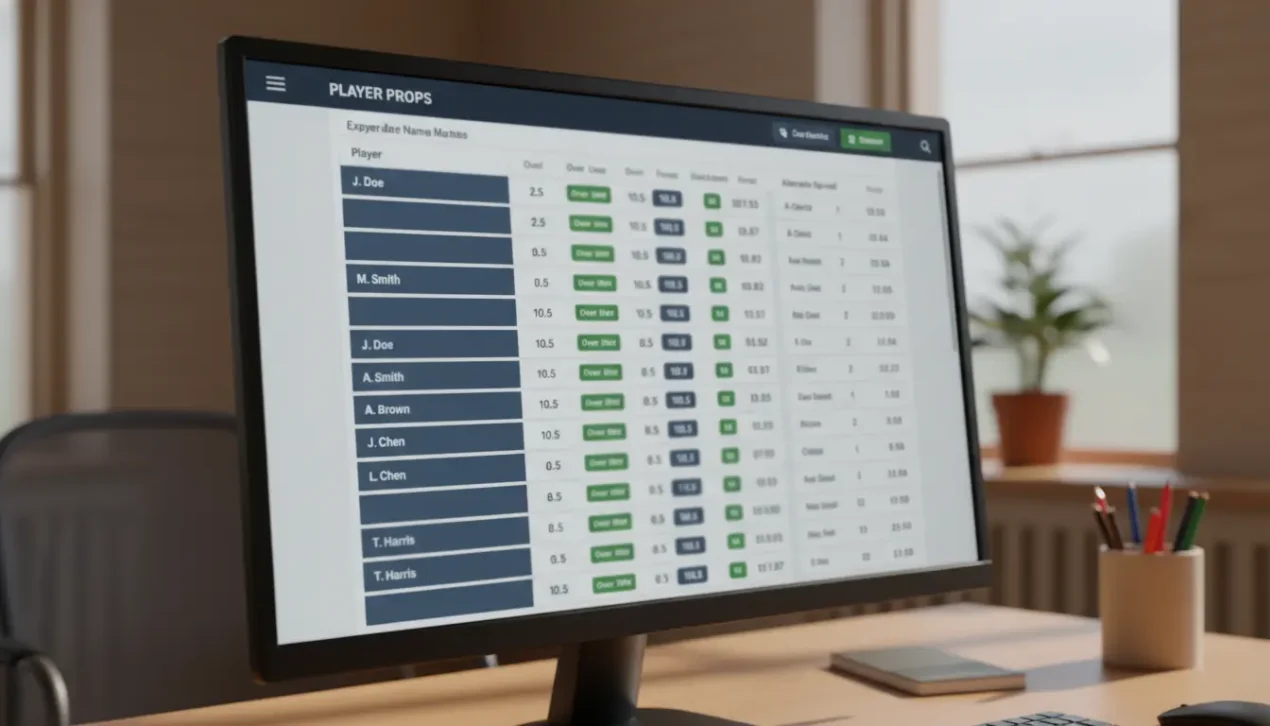
Why Crypto Books Go Deeper on Props Than Most Fiat Books
The first time I compared a single NBA game’s market tree across a state-licensed US sportsbook and a crypto-native book, the fiat book offered 47 markets and the crypto book offered 312. Same game, same teams, same tip-off. The difference in market depth wasn’t incidental — it reflected two totally different business models colliding with the same sporting event.
Crypto sportsbooks go deep on props for three reasons that add up cleanly. First, they don’t carry the regulatory overhead that forces licensed operators to submit every new market type for approval. Second, their underlying odds-modelling infrastructure is often leased from specialist B2B providers whose entire product is depth of markets. Third, props are where the operator’s margin is widest, and books with less brand equity in marquee markets compete on prop breadth to attract bettors who like to explore.
Altcoin-stake growth in iGaming partly reflects this dynamic. The altcoin share of crypto bets climbed from about 26.8 per cent in 2023 to roughly 47 per cent in 2024, and a big slice of that shift happened in prop markets where the stake sizes per bet are smaller and bettors are happier experimenting with non-BTC assets. Prop betting is where crypto books attract users who’ve matured past main markets and want depth, and it’s where those users pay the house’s widest margins in exchange.
How those prices are built is in odds formats.
The Prop Tree: From Outright to Fourth-Quarter Totals
Let me lay out the structure of a typical prop tree, because the naming conventions can be baffling when you first encounter them, and understanding the tree structure makes comparing markets much faster.
Outrights sit at the top. Match winner, tournament winner, season winner. These are the highest-liquidity, sharpest-priced markets on any book, and prop trees branch downward from them.
Main markets sit just below: total points, point spread, moneyline. The book prices these with the most model effort because they attract the most volume and the sharpest punters. Margins are typically 4-6 per cent on the main lines.
Period markets slice the match time. First half, second half, first quarter, fourth quarter. Each period has its own winner, spread, total markets. On a 4-quarter sport like basketball, a single game can have four quarter markets for each of winner/spread/total, plus two half markets for each, plus the full-game versions — that’s 18 time-segmented markets before you’ve touched player-specific props.
Player props are where the tree branches dramatically. For an NBA game, each starting player has prop markets on points, rebounds, assists, steals, blocks, three-pointers made, free throws made, minutes played, turnovers, double-doubles, triple-doubles. Ten players times ten prop types is 100 markets from the player layer alone. And that’s before same-game-parlay construction that lets you combine any of them.
Team props sit alongside. First team to score, team to lead at half-time, team to score X points in a quarter, team with most three-pointers. These tend to be thinner liquidity than player props but have their own active bettor community.
Specials and novelties round out the tree. Total fouls in the game, coach gets a technical, player specific scoring milestones. Crypto books will happily list 40 of these per game. Margins here are the widest in the entire tree — often 12-20 per cent — because the book has low confidence in its pricing and charges for that uncertainty.
Alt-Lines: Re-Pricing the Same Bet Many Ways
Alt-lines are the offering that crypto books have really run with, and they deserve a clean explanation. An “alt” is just a non-default version of a standard market — different spread number, different total number, different player-prop target — re-priced at odds that reflect the non-default threshold.
Worked example on an NBA game. The main spread is Team A -6.5 at 1.91 decimal. The alt-spread menu offers: Team A -1.5 at 1.50, Team A -3.5 at 1.68, Team A -6.5 at 1.91 (default), Team A -9.5 at 2.30, Team A -12.5 at 3.20. Each line is the same bet expressed at a different threshold, and the odds change to reflect the probability of covering that threshold.
Total-points alts work identically. The main total might be 218.5 at 1.91 over and 1.91 under. The alt menu offers under 210.5, under 215.5, over 221.5, over 225.5, each at different odds.
Player-prop alts are where crypto books offer what feels like infinite depth. A star player’s points prop might have the main line at 24.5 and alts at every 0.5 increment from 18.5 to 32.5. Fourteen different ways to bet on the same player’s points, each re-priced. For bettors with specific views, this is genuinely useful — if you think a player goes for exactly 26 points, you can structure a bet much more precisely than a single main line allows.
The operator’s case for alt depth: they collect more action because bettors with mildly non-consensus views have somewhere to put their money. A bettor who thinks a player scores “around 28” might avoid the main 24.5 line because it feels too conservative, but bet happily on the 27.5 alt. Net of this, books with deep alt menus capture more bettor types than books with narrow ones.
The risk for the bettor: alt lines are typically worse-priced than main lines on a hold-percentage basis. If the main line has 4 per cent hold, the alts around it might have 6-10 per cent hold. You’re trading price quality for customisation, and if you always bet alts, your edge is lower than if you discipline yourself to the sharpest lines available.
How Books Actually Price Prop Markets
Prop pricing is harder than main-market pricing, and the difference shows up in the margins books charge. Understanding why helps you identify which props are worth betting and which are traps.
Main-market pricing uses well-understood models — team strength ratings, point-spread history, total-points distributions. A book’s NBA main line for tonight’s Lakers-Warriors game is a function of thousands of historical data points, adjusted for current injuries and lineup changes. The model spits out a fair line, the book adds 4-5 per cent margin, the market trades.
Player-prop pricing is messier. A player’s points prop depends on expected minutes, expected usage rate, expected shooting percentage, defensive matchup, pace of play, and half a dozen other factors that interact nonlinearly. Books either run custom models on these — which is expensive and usually only done for top-tier markets — or they use heuristics based on recent performance that degrade in predictable ways when circumstances change.
The heuristic approach is why props often misprice in game situations books haven’t seen before. A backup point guard starting for the first time in three years has no recent performance baseline; the book’s prop lines on that player are genuinely guesses, and sharp bettors who’ve tracked the player’s historical performance can identify mispriced lines. This is legitimately where prop edges come from in serious betting.
The flip side: books know which of their prop markets are weakest, and they limit stakes accordingly. A main-line bet might allow A$10,000 at a crypto book; the same book’s prop on an obscure player might cap at A$200. Books are happy to take your A$200 on a market they’ve guessed at, but they won’t let you size up on it, because that would give sophisticated bettors too clean a shot at the pricing errors.
The specific feature that makes crypto-native esports betting distinctive — the sheer market menu depth — rhymes with the approach crypto sportsbooks take to traditional prop markets too. I’ve written about the esports-specific version of this market-depth logic in the piece on Bitcoin esports betting, and the pricing discipline that applies to esports props applies equally to traditional-sport props.
Where Prop Menus Bleed Your Bankroll
Props are the single most dangerous category of market for bankroll discipline, and I say this having watched myself bleed money on them for years before I got better. Let me flag the specific failure patterns.
Pattern one: spray betting. A prop menu with 300 markets invites clicking on many of them. Each click is a small stake that feels inconsequential. The problem is that the aggregated vig across 15 small bets at 8 per cent hold is far worse than one bet at 4 per cent hold on a main market. Spray betting across props is how recreational bettors pay the book’s maximum margin — multiple times per game.
Pattern two: specific-player loyalty. Every fan has favourite players whose props they over-bet because they “know” them. The book’s model doesn’t care that you follow that player closely. The book’s prop lines are priced to extract value from exactly this pattern. Fan-driven bettors are the most reliably profitable customer cohort for books running deep prop menus.
Pattern three: correlated same-game parlays. A same-game parlay combining “Team A wins” with “Star Player A scores 25+” is not two independent bets — they’re strongly correlated, because Team A is more likely to win if Star Player A is scoring. The book prices the parlay as if the legs were independent, pocketing the correlation difference. For highly correlated same-game parlays, the true price is far better than what the book offers, and the book’s margin can quietly expand to 20 per cent or more.
Pattern four: live-prop tilting. Main markets suspend during meaningful events, but prop markets often stay open longer with reduced limits. A bettor down on his main bets can chase losses through prop bets late in a match, at stakes the book is happy to accept because the book’s risk exposure is limited by the reduced caps. This is a reliably losing pattern and one that books structure to accommodate.
The disciplined approach. Set a per-game prop budget before the game starts. Stick to it regardless of how the game goes. Prefer main-line alternates over novelty props when you have an opinion. Be specifically sceptical of same-game parlays, which are almost always priced in the book’s favour beyond the nominal margin. And recognise that if a book’s prop menu has 300 markets, the book is profitable in aggregate precisely because bettors spread their action across all 300.
Do crypto books allow cross-sport prop parlays?
Some do, most don’t. Cross-sport parlays — combining an NBA prop with an NFL game prop and a La Liga result, for example — are legitimate independent events and could be priced fairly. Operationally, though, most books either prohibit cross-sport parlays or limit them heavily because the settlement logic is more complex and the user base for them is smaller. If your book allows them, check the rules on push handling carefully — the settlement edge cases can be ugly.
Why does the same prop have different limits across books?
Because different books have different exposure models and different trader confidence in specific markets. A book that specialises in NBA might confidently accept A$2,000 on a player points prop the same market’s general-sport book caps at A$200. The limit difference reflects how well each book has modelled the specific market, and specialist books often offer both better prices and higher limits on their areas of expertise.
Is there such a thing as a stable edge in player props?
Occasionally. The edges that persist come from specific situational insights — backup starters, injury-impacted rotations, coaching-change effects — where the book’s model is using stale data. These edges are small, hard to systematise, and often close quickly as books update their models. Treating prop betting as a consistent edge source is unrealistic for most bettors; treating it as occasional opportunity-hunting in specific situations is more defensible.
Created by the "" editorial team.The wider context sits in our data-driven guide to Bitcoin betting.