
Bitcoin Betting: The Complete Data-Driven Guide to Crypto Sportsbooks
Where on-chain data meets the sportsbook.
Loading...
What Bitcoin Betting Is, in Two Paragraphs
Nine years ago I placed my first wager from a hardware wallet on a late-night Premier League fixture, and the deposit confirmed in forty minutes. Last Saturday I pushed sats to a Lightning-enabled book from my phone while standing in line for a flat white, and the balance updated before the barista called my name. That is the arc this niche has travelled — from fringe curiosity to a payment rail faster than most card processors. "Bitcoin betting" sounds like a product category, but it is really a payment and custody architecture underneath a sportsbook you could otherwise recognise.
You send Bitcoin or another supported crypto — increasingly a stablecoin — to a sportsbook's deposit address, the operator credits your balance, you stake on markets that look identical to any licensed fiat book, winnings settle back to your wallet on withdrawal. What differs is under the hood: funds move on public blockchains, settlements take minutes rather than banking days, and a meaningful share of operators run without card-processor gatekeepers. Two numbers frame the scope. Global crypto gambling reached $81 billion in 2025, built on deepening blockchain integration and play-to-earn models layered onto classic sports wagering. And Bitcoin's share of crypto-denominated iGaming bets fell by more than seventeen percentage points in 2024, with stablecoins and altcoins eating the difference. The rest of this guide unpacks what those shifts mean for anyone about to make their first BTC-funded wager.
How this guide is structured. Data defining the market, then mechanics, legality, safety, privacy, fees, bonuses and the less comfortable side — the overlap between trading and gambling disorder.
Nine Data Points That Define Bitcoin Betting in 2026
- Crypto-casino wagers hit twenty-six billion dollars in Q1 2025 alone, nearly double the prior year — the market is no longer niche.
- Bitcoin dominance inside crypto gambling slid from eighty-eight to seventy-seven percent in a single year as Tether absorbed the difference.
- The Curaçao LOK reform that took effect on 24 December 2024 ended the old master/sub-licence architecture that most offshore books relied on.
- Illicit addresses pulled in one hundred and fifty-four billion dollars in 2025, which is why "no-KYC" rarely means what bettors think it means.
- Budget for a two to four percent effective cost on deposits and withdrawals, build around a licensed book with transparent wallet policy, and keep your staking in the range you would use on a fiat book.
Bitcoin Betting At a Glance: Six Metrics That Matter
When someone asks whether crypto wagering is "big" or "still a hobbyist corner," I reach for the same handful of numbers. Not because they flatter the category — some are uncomfortable — but because they bound it.
Global crypto gambling market
Eighty-one billion dollars reached in 2025, underpinned by deeper blockchain integration and play-to-earn expansion.
Crypto-gambling market CAGR
From roughly two hundred and fifty million dollars in 2024 toward a forecast four hundred million by 2028, compounding at 12.5 percent annually.
Mobile share of crypto iGaming bets
Sixty-four percent of crypto wagers came from phones in SOFTSWISS data; desktop sits around thirty-two percent, with the forecast pushing eighty percent mobile by 2026.
In-game currency conversion
Ninety-three percent of crypto bets pass through the operator's in-house conversion tool — your odds are usually frozen in fiat even if your balance reads in BTC.
Stake.com monthly handle
Around ten billion dollars in monthly wagers — roughly four percent of annual Bitcoin transactional volume runs through a single operator.
Regulatory spread
Seventy-five percent of jurisdictions have either launched or are drafting crypto-specific gambling rules; the grey zone is shrinking fast.
Read together: this is not a speculative hobby market anymore, mobile dominates, and the "I will bet in BTC" fantasy often collides with an in-house conversion layer most bettors never notice. The single-operator concentration number is the striking one — one book running four percent of Bitcoin's monthly transaction flow is infrastructure-level footprint, not a side hustle.
Stake.com pulls in at least one hundred and twenty-seven million monthly visits across its domains, and estimates place the company's valuation between fourteen and twenty-three and a half billion dollars in 2025. That is what one operator alone represents — the category as a whole is substantially larger.
How Big Is the Crypto Betting Market, Really
A reporter once asked me, over a coffee in Sydney, whether crypto gambling was "a real industry or just Telegram hype." I pushed a napkin across the table with 2019 and 2024 on it and wrote the market sizes beside them. He went quiet for thirty seconds. That is usually what the data does when you line it up honestly.
The crypto gambling market sat at around $50 million a year in 2019. By 2024 it had reached roughly $250 million. The forecast line runs toward $400 million by 2028 at 12.5 percent annual compounding. Those are the conservative tracked numbers. The looser SIGMA World figure puts global crypto gambling at $81 billion in 2025, pulling in adjacent play-to-earn and blockchain-gaming flows. Both are true; they measure different things.

For sports betting specifically, crypto-casino wagers alone hit roughly $26 billion in Q1 2025, almost double the same quarter a year earlier. Year-round, total transaction value for crypto gambling cleared $15.8 billion in 2024. That is three to five percent of total online gambling activity, growing at a multiple of the legacy fiat book rate.
Polymarket's prediction-market volume jumped from $62 million in May 2024 to $2.1 billion by October 2024 — a 3,268 percent climb in five months.
Regionally, Europe accounts for roughly forty percent of global crypto gambling, Asia thirty-five, and Latin America — Argentina, Brazil, Venezuela — is the fast-growing tail. Forecasts have Asia at forty percent share by 2026 with LatAm adoption doubling. Africa's compound growth is the loudest number: a 45 percent CAGR, highest of any region. Bitcoin matters in those markets precisely because local payment rails often do not.
The demographic profile is narrower than most people assume. SOFTSWISS data puts sixty-five percent of the crypto iGaming audience as male, seventy percent between thirty-one and fifty years old. These are people with disposable income, technical confidence, and a prior relationship with crypto as a financial instrument rather than a meme.
An operator quote that sums up the commercial pull better than any analyst report: "Integrating crypto payments allows iGaming businesses to operate globally, delivering greater speed and convenience." — Vitali Matsukevich, SOFTSWISS COO, 2025 iGaming Trends report. Fifty-eight percent of SOFTSWISS survey respondents named crypto the main growth driver in new markets.
Two contradictory currents run through the near-term picture. Online gambling as a whole is projected to climb from $89.48 billion in 2025 to $228.57 billion by 2035 at 9.83 percent annually. Crypto's sub-segment grows faster off a smaller base. But the crypto slice also moves more violently with BTC price. In 2024, Crypto Bet Sum rose 18.7 percent year on year while Bet Count fell 12.8 percent — players wagered bigger amounts less often as BTC appreciated. If you are trying to forecast volume in 2026, you are really forecasting Bitcoin's range-bound versus trending behaviour. I have never found a reliable way to do that, and neither has anyone else.
The Coin-Mix Shift: Why BTC Is Losing Share to Stablecoins
A friend who runs a small crypto-sports syndicate since 2017 called me two years ago and said, "I am going to stop thinking in BTC terms. I am settling everything in Tether. I am a bettor, not a holder. I do not want my bankroll moving ten percent overnight because someone at the Fed coughed." That conversation captures the most important structural change in crypto betting, and almost nobody writes about it properly.
The data is striking. In 2024, Bitcoin's share of crypto-denominated iGaming bets fell by more than seventeen percentage points. Tether gained 7.3, Litecoin 6.5, Ethereum 3.4. Altcoin share climbed from 26.8 percent in 2023 to roughly forty-seven in 2024. In 2025, CryptoManiaks reported BTC dominance inside crypto gambling dropped from eighty-eight to seventy-seven percent — the monopoly cracking.
| Axis | Betting with BTC | Betting with USDT |
|---|---|---|
| Volatility on a pending bet | Full BTC exposure — a ten-percent move while settling is routine | Anchored near $1 — bankroll stays flat |
| On-chain fees | Low on Lightning, meaningful on L1 during congestion | Tron and Polygon cost cents; Ethereum mainnet can bite |
| Settlement finality | Conservative books need 2–3 L1 confirmations | Instant on Tron, a few blocks on Polygon or BSC |
| Regulatory profile | Commodity framing in most jurisdictions | Stablecoin regulation is the fastest-evolving surface globally |
Sports bettors are not crypto investors. When BTC ran from $30,000 to $100,000, every bet became two: the sporting bet and a long position on Bitcoin. Most bettors do not want that correlation. Tether removes it. Litecoin appeals because fees are predictable and confirmations fast. Ethereum grew because DEX-native sportsbooks settle in ETH-adjacent assets.
Tether's monthly on-chain volume runs around $703 billion with a peak of $1.01 trillion in June 2025 — more monthly flow than most national payment systems.
Vitali Matsukevich put the operator perspective this way in the SOFTSWISS 2024 Annual Report: "The sharp appreciation of Bitcoin in the final quarter of 2024 led to a more conservative approach among players toward crypto betting. At the same time, the increased value of Bitcoin resulted in higher average bet amounts, positively impacting the overall Crypto Bet Sum." The same dynamic that pushed average crypto bet size up 1.4 times in 2024 also pushed players toward stablecoins for bread-and-butter wagers.
If you hold BTC as a long-term asset, do not mix your betting bankroll with your holding stack. A stablecoin bankroll sized in dollars and wagered in dollars removes an entire category of regret. Bitcoin as a deposit rail is still unmatched for neutrality and Lightning speed. Bitcoin as a betting unit of account is a decision that needs conscious thought, not default behaviour.
How a Bitcoin Bet Travels From Wallet to Settlement
The clearest way to understand what makes a Bitcoin bet structurally different from a card-funded one is to watch where the money sits at each step. On a fiat book, your deposit is a claim on the operator's settlement account with an acquiring bank, credited on a reversible rail. On a crypto book, your deposit is a blockchain record that has already moved — irreversibly — from one address to another. That single fact changes downstream behaviour in a dozen small ways.
For the engineering-grade walkthrough, read how Bitcoin sports betting actually works from deposit to settled wager. Here I sketch the shape.
A worked example: a 0.005 BTC wager on a Friday-night fixture
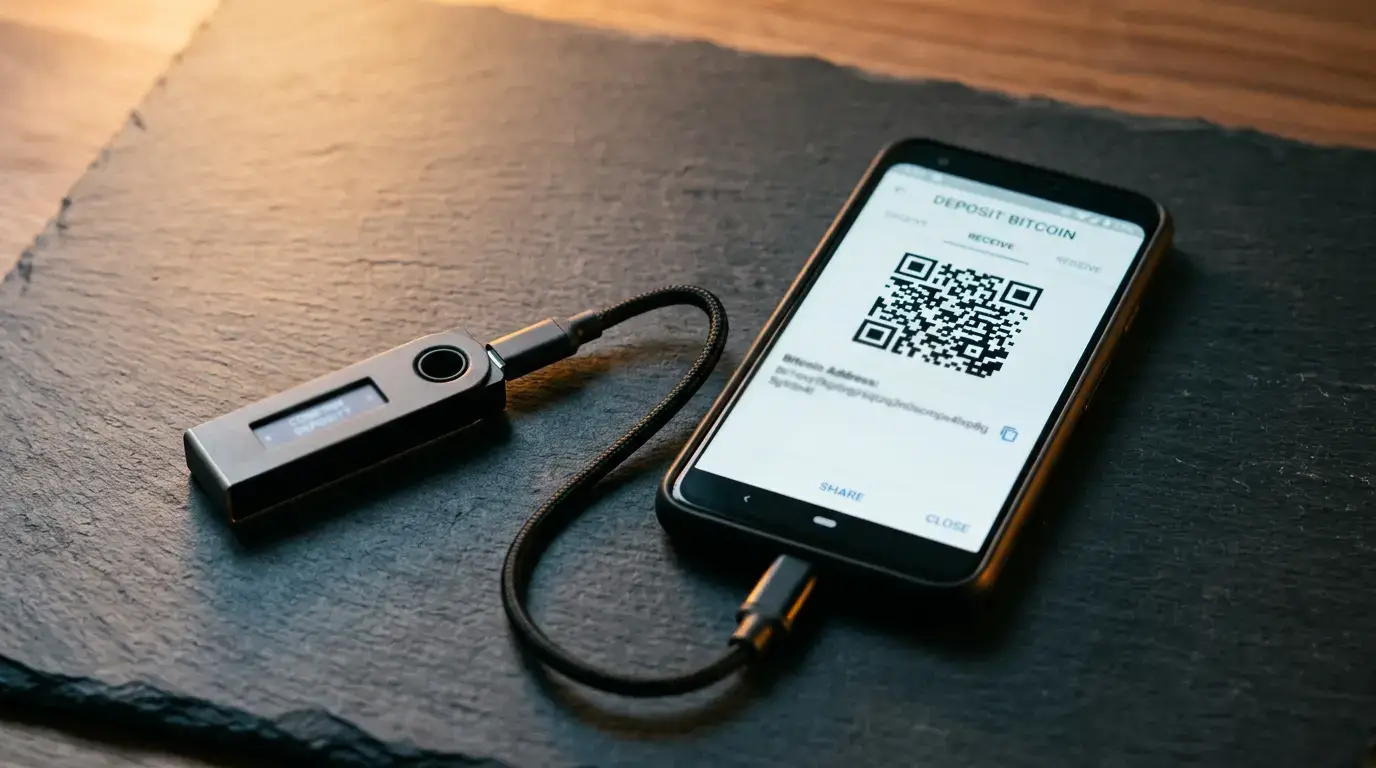
Step 1 — Deposit address. You hit deposit and the operator shows a unique BTC address (often SegWit or Taproot) or a Lightning invoice. Copy carefully. Address-pasting errors are among the most expensive mistakes a crypto bettor makes.
Step 2 — Send 0.005 BTC. On Lightning, the invoice settles in one to three seconds for a negligible fee. On L1, you set a fee tier — say 15 sat/vB during a calm mempool — and broadcast.
Step 3 — Confirmations. Most crypto sportsbooks credit L1 deposits after one to three confirmations, so fifteen to thirty minutes from broadcast to bettable balance. Ninety-three percent of crypto bets pass through the in-game conversion tool here, so your 0.005 BTC appears as a fiat-equivalent balance at the book's quoted rate.
Step 4 — Stake placement. You build a slip, the book quotes odds (American or decimal in English-speaking markets, fractional still common on cricket and racing), you confirm. Nothing hits a blockchain here.
Step 5 — Settlement. Final whistle, result verified, slip settles. Balance updates instantly.
Step 6 — Withdrawal. You request a withdrawal. The book signs and broadcasts — typically batched with other payouts. Lightning: near-instant. L1: one confirmation window after the queue releases.
The in-game conversion tool is where a lot of the "Bitcoin experience" disappears. Ninety-three percent of the time, once your BTC is deposited your bankroll is effectively denominated in the operator's fiat reference unit. You are betting in dollars, funded in sats. The upside: you are not exposed to a twenty-percent BTC move while your futures ticket waits for a tournament to end. The downside: the "pure crypto bet" mystique is largely an illusion.
On fiat-on-ramp dominance. Chainalysis tracked more than $1.2 trillion in fiat-to-Bitcoin on-ramps between July 2024 and June 2025 — roughly seventy percent more than Ethereum's equivalent. Even bettors planning to wager in Tether usually buy BTC first and swap internally.
The biggest mental shift is that the blockchain part lives at two specific moments — deposit and withdrawal — and the rest of your time on the book is functionally identical to using a fiat sportsbook. Speed, privacy and censorship-resistance advantages all live at those two choke points.
Is Bitcoin Betting Legal? A Jurisdictional Overview
"Is it legal?" compresses three questions: where is the operator licensed, is the operator allowed to accept players from your country, and are you permitted to use that operator from your jurisdiction. Those answers diverge sharply in some places, and "legal" becomes meaningless shorthand.
For the exhaustive country-by-country framework, read the cluster on the global jurisdictional framework for bitcoin betting in 2026. What follows is the overview I wish every new bettor read first.
Roughly seventy-five percent of jurisdictions have implemented or are drafting dedicated crypto gambling regulation. Regulatory silence is over. In Australia, the Interactive Gambling Act does not distinguish between fiat and crypto at the statutory level — an offshore crypto book accepting Australians operates in the same grey-to-black zone as an offshore fiat book.
| Region | Practical regulatory stance | What it means for bettors |
|---|---|---|
| United Kingdom | No crypto-specific licence class; licensed UK operators rarely accept BTC | Betting with BTC means an unlicensed-in-UK operator |
| Curaçao post-LOK | Master-sub-licence regime ended 24 December 2024; direct B2C licences under new rules | Many legacy sub-licensed books had to restructure or close |
| Australia | IGA prohibits unlicensed online sports services; crypto is not a special category | Offshore crypto books accept Australians but are not licensed in-country |
| United States | Federal UIGEA plus 50 state regimes; offshore crypto books widely used but grey-to-black | State-dependent and enforcement-risk-dependent |
| EU member states | MiCA governs crypto assets; gambling remains national | Case by case — Germany, Malta, Estonia differ substantially |
The Curaçao story is the single most important regulatory development in this niche in the last decade and almost never gets reported correctly. The LOK ordinance came into force on 24 December 2024, terminating the master-sub-licence system most offshore crypto books had relied on since the early 2010s. Under the old regime, a handful of masters sold sub-licences cheaply and a thousand-plus operators ran with effectively no oversight. LOK killed that. B2C licence cost under direct-licensing is around €47,000 a year, B2B around €24,000. Finance Minister Javier Francisco Antonio Silvania was blunt: "Offering these services will not be possible with a Curaçao licence for the time being," he said about crypto-gambling activities. In July 2025 the Curaçao Public Prosecutor's Office announced the first-ever accountability action against the industry, fining twelve operators roughly $12,500 each. The prosecutor: "This is the first time the Curaçao online gambling industry has been held accountable."

UK data calibrates what a mature regulated market looks like. Gross Gambling Yield for April 2024 to March 2025 reached £16.8 billion, up 7.3 percent year on year. Online GGY for October to December 2025 ran at £1.5 billion, with the count of bets rising 6 percent to 27.4 billion. Twelve point seven million monthly active accounts. The Gambling Commission does not permit BTC deposits at its licensees.
Check the operator's licence and geography blocks at signup, not the promotional page. "We accept players from your country" is not a legal opinion. The direction of travel is toward more enforcement. Nothing in this section is legal advice — if you are serious about a wagering strategy involving meaningful capital, a local gambling lawyer is worth a tenth of what you will spend on your first bad weekend.
How Safe Is Bitcoin Betting? On-Chain, Custodial and Regulatory Risks
I keep a mental taxonomy when a new bettor asks me if a book is "safe." There are six different risks sitting inside that one word: the operator stealing funds, the operator freezing withdrawals, a wrong-chain mistake, an AML clawback on winnings, a regulatory ban arriving out of nowhere, and a hack at your own end. Each is a different problem with a different mitigation. Lumping them together is how people get hurt.
The deeper treatment lives in the cluster on operational, custodial and on-chain risks in Bitcoin betting. Here, a mental ranking.
Regulatory-adjacent risk is now empirically large. Chainalysis's 2026 Crypto Crime Report estimates illicit crypto addresses received at least $154 billion in 2025 — a 162 percent year-on-year jump, with sanctioned-entity volume up 694 percent. Sportsbooks sit on the compliance frontline of that data. When a book's chain-analytics vendor flags your withdrawal as having touched a previously mixed address — even two hops removed — that is how a "no-KYC" account suddenly gets a verification request. Stablecoins now account for sixty-three percent of illicit on-chain volume.
The Chainalysis line every bettor should internalise: "Illicit crypto activity is scaling. In 2025, illicit crypto addresses received at least $154 billion, a 162% year-over-year increase, driven by a 694% surge in sanctioned entity activity and record-setting thefts by nation-state actors." Your operator reads this report. So should you.
Custodial risk has historically cost bettors the most money. When a sportsbook holds your BTC, your legal claim depends entirely on the operator's domicile — and most crypto books sit in jurisdictions where bettor-protection insolvency regimes do not exist. A book that stops processing withdrawals because it is insolvent treats your request exactly like one from a blacklisted player. The only structural protection is segregated wallets or verifiable cold storage, and even then you rely on the operator's honest disclosure. Forty-eight percent of blockchain-gaming platforms had AML and KYC protocols in 2025; twenty-eight percent came under regulatory review in the same year. Floor, not ceiling.
Operational risk — frozen withdrawals, downtime during major events, support silence — is the most common, least-discussed category. On-chain risk is tactical: wrong-network deposits, underfunded fees, mempool congestion. Recoverable if you notice fast.
Do
- Verify the deposit address by triple-copy-paste and a small test send
- Use Lightning for small, frequent deposits
- Enable 2FA on a hardware authenticator, never SMS
- Read the withdrawal policy before your first deposit
- Withdraw frequently so custody exposure stays below what you could afford to lose
Don't
- Send L1 BTC to a Lightning invoice or vice versa
- Assume "no-KYC" means you will never be asked for ID
- Fund a book from an exchange address that handles your long-term stack
- Trust a book's published cold-wallet balance without on-chain verification
- Run a significant bankroll without considering what happens if the book vanishes tomorrow
"Safe" is the sum of operator, bettor, network conditions and regulatory environment. You control about half the variables. My heuristic: if a book does not let me verify the things I care about, I do not deposit enough on it to care about the answer. Your deposit size is the most honest statement you will make about how much you trust a particular operator.
The No-KYC Question: What Privacy Actually Means on a Crypto Sportsbook
I have a mental trick for newcomers drawn to crypto betting by the "anonymous" angle. I ask them to describe their threat model. Nine times out of ten they cannot, because what they actually want is not anonymity — it is the absence of paperwork. Real anonymity against a motivated adversary is a surveillance-engineering project. The absence of paperwork is a signup flow. Conflating the two is how people end up surprised when a book freezes a five-figure withdrawal pending ID.
For the full taxonomy of privacy levels, trigger events, and operational realities, the cluster on what anonymity really looks like today in no-KYC Bitcoin betting is the detailed treatment.
Forty-eight percent of blockchain-gaming platforms had AML and KYC protocols in 2025, with projections putting ninety-five percent of crypto gambling platforms on AML tooling by year-end and eighty percent running tokenised loyalty programs. Almost every operator runs chain-analytics on your deposits and withdrawals regardless of whether they ask for a passport at signup. "No-KYC" has drifted to mean "no KYC at signup unless you trigger a threshold."
What triggers KYC on a "no-KYC" account. Cumulative withdrawals above a book-specific threshold (often 0.5 to 2 BTC equivalent). A funding source flagged as high-risk. A sudden geographic IP change. A betting pattern the risk team reads as exploitative. A regulatory inquiry from any jurisdiction the operator cares about.
Most commentary in this space goes wrong by presenting the choice as binary — "KYC books" versus "no-KYC books" — when in practice it is a spectrum. At one end, fully licensed operators requiring KYC at signup. Next, KYC at first withdrawal. Next, KYC only above a threshold. Next, KYC only when risk systems flag you. At the far end, provably-fair DEX sportsbooks where the operator never holds custody and never sees your identity — trading one risk class for smart-contract and liquidity risks most bettors underweight.
An honest self-check before choosing a no-KYC operator: if your account is frozen tomorrow with funds inside, and the operator asks for ID to release them, will you comply? If yes, you never wanted anonymity — you wanted convenience. Plan accordingly. If no, your bankroll size should match the amount you are willing to walk away from.
Privacy on a custodial book is a comfort illusion, useful for reducing friction but not for defeating determined analysis. Privacy on a non-custodial DEX book is structurally stronger but trades risk classes. The convenience of skipping a signup form is worth what it costs in saved friction — ten minutes and some email spam. Not worth structuring a serious bankroll around.
Fees and Withdrawal Speed: Where Crypto Really Beats Fiat
If I had to pick a single reason this category grew the way it did, it would not be anonymity, bonuses or geography arbitrage. It would be that card-funded sportsbooks cannot pay you on a Sunday afternoon and crypto books can.
Lightning Network public channel capacity scaled to 5,000 BTC by the start of 2025 — a 384 percent increase since 2020 — across roughly 16,000 nodes and 75,000 active channels. Layer-2 solutions are projected to cut crypto gambling fees by roughly ninety percent relative to L1 baseline costs.
Round-trip cost of a 0.01 BTC cycle
Deposit leg. Calm mempool at 20 sat/vB, typical SegWit transaction around 140 vBytes. Fee: roughly 2,800 sats, about $2.80 at a $100k BTC price. On Lightning: a few cents.
In-game conversion. Typical spread 0.2 to 1 percent relative to market midpoint. On a 0.01 BTC deposit at $100k, $2 to $10 invisible cost.
Wager. No on-chain fee. Vig ranges 2.5 to 10 percent by market.
Withdrawal leg. On L1, another 2,800 sats. On Lightning, a few cents. Reverse conversion spread adds another $2 to $10.
Round-trip friction: roughly $10 to $25 per 0.01 BTC cycled. Two to two and a half percent. Compare to three percent card-deposit plus a $10 to $20 wire-withdrawal fee on a fiat book.
The speed comparison is starker. Card deposits to fiat sportsbooks are instant, but withdrawals take one to five business days. On a crypto book, Lightning is seconds to minutes both directions. L1 BTC deposits are fifteen to thirty minutes for one to three confirmations. Withdrawals depend on the book's processing window — most reputable books release within an hour.
Odds formats
American: NBA moneyline at -110. Stake $100, potential win $90.91.
Decimal: same market at 1.91. Stake $100, total return $191, profit $91.
Fractional: 10/11. Stake of eleven, profit of ten.
On a crypto book, your balance might read 0.001 BTC or 100 USDT. The underlying odds are identical to a fiat book — only the unit on the balance column differs.
Crypto books give you a real cost-and-speed advantage on bankroll movement, typically two to three percent round trip compared to three to six on fiat. That compounds brutally for anyone cycling funds weekly rather than quarterly. For a casual weekend bettor who deposits once and withdraws once a year, the differential is almost invisible. For anyone running a serious approach, it is the largest single edge the category offers.
Bitcoin Betting Bonuses and Bankroll Sizing
The first crypto sportsbook bonus I ever accepted cost me money. Not directly — I met the rollover — but three hundred dollars of bonus BTC turned into a six-week rabbit hole of tracking EV, rollover progress and market restrictions. BTC bonuses are rarely free money. They are usually a salary for extra work.
The full architecture — welcome bonus math, reload mechanics, VIP thresholds, tokenised loyalty — is the cluster's territory: Bitcoin betting bonuses and bankroll strategy for crypto wagerers.
Two anchoring numbers. Average crypto bet size rose 1.4 times in 2024 while the average fiat bet stayed flat. Stake.com generated $4.7 billion in revenue in 2024 despite being blocked in the US, UK, Italy and Denmark. That tells you how much the crypto audience is willing to wager when the rails are smooth.
The bankroll rule I follow. Never more than five percent of total crypto-wagering bankroll on any single operator. Never a single bet larger than two percent of that on-book balance. You are sizing against operator failure, not just against losing the match.
Why operator caps matter more than in fiat: crypto books fail at rates higher than licensed fiat books, and recovery is harder. A fiat book bankruptcy in a regulated jurisdiction has a legal process; a crypto book collapse in a jurisdiction where the licence just got cancelled often does not.
The bonus arithmetic is where new bettors lose the thread. A typical BTC welcome bonus: 100 percent match up to 1 BTC, 40x rollover at minimum odds 1.50. One BTC bonus, 40x rollover, equals 40 BTC of wagering. At a 5 percent vig, the expected cost of churning 40 BTC at -110 odds is roughly 2 BTC. Your bonus EV is not +1 BTC — it is -1 BTC in expectation. If you can meet the rollover on bets you would have placed anyway, EV turns positive. If you are placing extra bets to clear it, you are paying the casino to hold your money for a month.
Before you accept a BTC bonus
- Calculate total wagering in BTC terms, not percentage terms
- Multiply by the book's vig to estimate bonus-chasing cost
- Read which markets count — many exclude low-margin wagers
- Check the expiry window and confirm you wager at that pace naturally
- Confirm withdrawal conditions — some bonuses trigger KYC at first withdrawal
- Never scale up your stakes to chase a bigger bonus
The healthier your bankroll discipline, the less any individual bonus matters. Treat bonuses the way a fund manager treats rebates: nice when they arrive, never a primary driver of strategy.
The Data Nobody Shows You: Crypto Trading, Problem Gambling and You
Among regular crypto traders, 33.7 percent display problem gambling behaviour on validated screening instruments, 33.9 percent are at-risk, only 32.4 percent are non-problematic. Sample size seven hundred, peer-reviewed. Two out of three crypto traders screen positive for gambling-related harm before they ever sit down at a sportsbook. The base rate of problem behaviour in your population is materially higher than in the general gambling population. The top-ten affiliate pages on this keyword will not tell you that.
Mills and Nower, 2019: "Trading cryptocurrencies is strongly associated with problem gambling severity (r = 0.53, p < .001)." A correlation of that magnitude in behavioural research is not noise. Twenty-four-hour liquidity, outcome uncertainty, short-horizon dopamine — the cognitive mechanics of crypto trading are close enough to gambling that the same individuals struggle with both.
Oksanen and colleagues on the longitudinal picture: "Cryptocurrency trading is a risky activity and associated with a higher rate of excessive gambling over time. Such activity is especially risky among offshore online gamblers, who could view cryptocurrency trading as another form of gambling or as a way to make money for gambling." The offshore context — exactly where most crypto sportsbooks sit — is their most elevated-risk setting.
The PLOS One data adds texture. Across 24,234 addresses on an Ethereum-based DEX gambling platform, the typical player spent around $110 a day across a median of six bets; the heavily involved tail spent roughly $100,000 across 644 bets over a 35-day window. The researchers: "the average decentralised gambling application player spends less than in other online casinos overall, but the most heavily involved players in this new domain spend substantially more." The tail is what the industry monetises — and what pays the highest human price.
Why crypto amplifies risk is not mysterious. A fiat bettor who loses a weekend waits until Monday to move more money. A crypto bettor refunds, re-deposits and re-wagers in eight minutes on Lightning. The cooling-off period a regulated card processor imposes by accident is missing.
Signals it is time to step back
- You check wallet or book balance more often than the match score
- You have re-deposited after a loss in the same session more than twice in a month
- You have increased stake sizing to chase a losing week
- You have started trading crypto primarily to fund more betting
- You are concealing betting activity from someone you would not conceal spending from
Protective practices
- Fund a dedicated betting wallet separate from your holding stack
- Use operator deposit limits — lower them once, never raise after a loss
- Place bets only after the day's other decisions are made
- Take real breaks — a month, not a weekend
- In Australia, Gambling Help Online is the national free-and-confidential service
Most guides bury responsible-gambling content in the footer as a legal disclaimer. That is backwards. Knowing the 33.7 percent figure before your first wager is the most useful fact I can give you.

Your First Bitcoin Bet: A Pre-Flight Checklist
Everyone remembers their first deposit mistake. Mine was underfunding the fee on an L1 transfer in 2018 during the holiday mempool crunch. Eight hours stuck unconfirmed, watching the betting window close. What I wish I had had that day was a six-item checklist someone handed me. This is that checklist.
Before your first deposit — six checks
- Confirm the operator holds a verifiable licence in a jurisdiction whose regulator actually enforces. A Curaçao direct B2C licence post-LOK is meaningfully stronger than a legacy master-sub arrangement
- Read the withdrawal terms and identify the KYC trigger threshold before you sign up, not after you win
- Pick your funding network deliberately. L1 BTC for deposits above roughly 0.01 BTC, Lightning for smaller amounts, Tron or Polygon stablecoins if you want to remove BTC price exposure
- Do a test deposit of a small amount — 0.0005 BTC or ten dollars USDT — before moving any meaningful balance
- Enable 2FA on a hardware or software authenticator, never on SMS
- Set a weekly deposit limit at signup, below what you think you can afford
Do on your first session
- Place your first bet at a size below your comfort line
- Withdraw a portion of any winnings immediately, to validate the full round trip
- Save the withdrawal transaction ID and note the total elapsed time to your wallet
- Read the book's markets inventory for the sports you actually follow
Don't on your first session
- Deposit everything at once
- Claim a welcome bonus before you understand the rollover math
- Place a parlay as your first wager — variance eats data-collection value
- Skip the test deposit because the address "looks fine"
- Give the book a funding source that overlaps with your long-term holdings
The checklist is not about being cautious for its own sake. It is about building a reliable mental model of the operator, the payment rail and your own behaviour at a size where mistakes are forgettable. Every serious bettor I know ran at one-tenth their eventual stake size for the first thirty days on any new operator. The ones who did not, paid tuition in a way that left a scar.
Frequently Asked Questions
Is bitcoin betting legal in most countries?
Three questions hide inside that one: the operator's licence, the operator's acceptance of your country, and your country's rules on offshore betting. Roughly seventy-five percent of jurisdictions now have or are drafting crypto-specific gambling rules. In Australia, the IGA treats offshore online sports betting as unlicensed regardless of funding rail. In the UK, licensed operators do not accept BTC, so betting with Bitcoin effectively means using an operator outside Gambling Commission oversight. In the US, the answer is state-by-state. Assume "it is complicated where you live" and verify locally.
Is it actually safer to bet with Bitcoin than with a credit card?
Safer against different threats. A crypto book cannot run an unauthorised charge on your funding source because you push funds rather than authorise a pull. You are not exposing card numbers. But you pick up new risks — custodial risk on the operator's wallet, wrong-network sends, and AML flags if your funding addresses trip analytics. Chainalysis reported at least $154 billion received by illicit addresses in 2025, which is why books run chain-analytics on every deposit regardless of KYC.
How does a Bitcoin bet work from deposit to payout?
Six steps. Generate a deposit address. Send BTC on L1 or Lightning. Wait for confirmations — one to three on L1 — before the book credits an internal balance usually denominated in fiat. Build a slip and stake. The operator settles against the result. Request a withdrawal; the book broadcasts back to your wallet. Ninety-three percent of crypto bets pass through in-game currency conversion, so the blockchain phases happen at deposit and withdrawal only.
Do bitcoin sportsbooks really operate without KYC?
Some do at signup, almost none unconditionally. Forty-eight percent of blockchain-gaming platforms had AML and KYC tooling in 2025, with projections above ninety percent by year-end. "No-KYC" means "no KYC at signup unless you trigger a threshold" — cumulative withdrawal size, deposit velocity, geographic IP changes, or a chain-analytics flag. An operator can convert your account at any point; when that happens your funds are pending until you comply.
How long does a bitcoin withdrawal take in practice?
Lightning: seconds to a couple of minutes. L1 BTC: most books release within an hour, plus one confirmation, so another ten to twenty minutes. Tron-based USDT often lands within a couple of minutes. Total is typically under an hour for most rails, against one to five business days on fiat book card withdrawals. The operator's processing window is almost always the bottleneck, not the blockchain.
Are the fees on crypto sportsbooks lower than on fiat ones?
Round-trip fees on crypto are typically two to three percent of bankroll movement, compared with three to six percent on fiat when you count card deposits and wire charges. The advantage compounds for bettors who cycle funds weekly rather than quarterly. Layer-2 scaling should cut fees by roughly ninety percent over time. The hidden cost is the in-house exchange rate spread, often 0.2 to 1 percent per leg and not on any fee schedule.
Can I bet with stablecoins or altcoins instead of BTC?
Yes, and most crypto books support multiple assets. Bitcoin's share of crypto-denominated iGaming bets fell by more than seventeen percentage points in 2024; Tether gained 7.3, Litecoin 6.5, Ethereum 3.4. BTC dominance inside crypto gambling dropped from 88 to 77 percent in a single year. Tether is the default for bettors who want to remove BTC price exposure. The choice comes down to whether you want your bankroll moving with crypto markets while wagers are pending.
A Short Glossary for Bitcoin Bettors
The terms that come up most in my inbox.
On-chain — a transaction recorded directly on the Bitcoin blockchain, as opposed to off-chain rails like Lightning. Slower and more expensive but settles to the base ledger.
Lightning Network — a Layer-2 payment network on top of Bitcoin that settles between parties through payment channels. Near-instant, near-free. Public channel capacity reached 5,000 BTC in early 2025.
Confirmation — a new block mined on top of the block containing your transaction. Most crypto sportsbooks credit L1 deposits after one to three confirmations, which is fifteen to thirty minutes from broadcast.
In-game currency conversion — the operator's practice of converting your crypto deposit into an internal fiat-denominated balance for the duration of your session. Ninety-three percent of crypto bets pass through it.
No-KYC — no identity verification at signup. In practice: "no KYC unless you trigger a threshold" rather than unconditional anonymity. Thresholds vary by operator.
Provably fair — a cryptographic mechanism that lets a bettor verify the outcome of a random event was not tampered with after the bet was placed. Common on crypto casinos, less relevant on pure sports markets.
Rollover — the total wagering required to convert bonus credit into withdrawable balance. A 40x rollover on a 1 BTC bonus means 40 BTC of wagering. Most of the apparent value is absorbed by the vig paid across rollover.
Vig (vigorish) — the margin a sportsbook builds into its odds. A two-way market at -110/-110 has roughly 4.5 percent vig. Crypto sportsbooks range from sharp books near 2.5 percent to recreational books above 8.
Curaçao LOK — the National Ordinance on Games of Chance that came into force 24 December 2024, ending the master-sub-licence architecture most legacy offshore crypto sportsbooks relied on.
Chain analytics — scoring a wallet's history against known high-risk addresses to produce a risk rating. Operators use it to flag deposits and withdrawals for enhanced review.